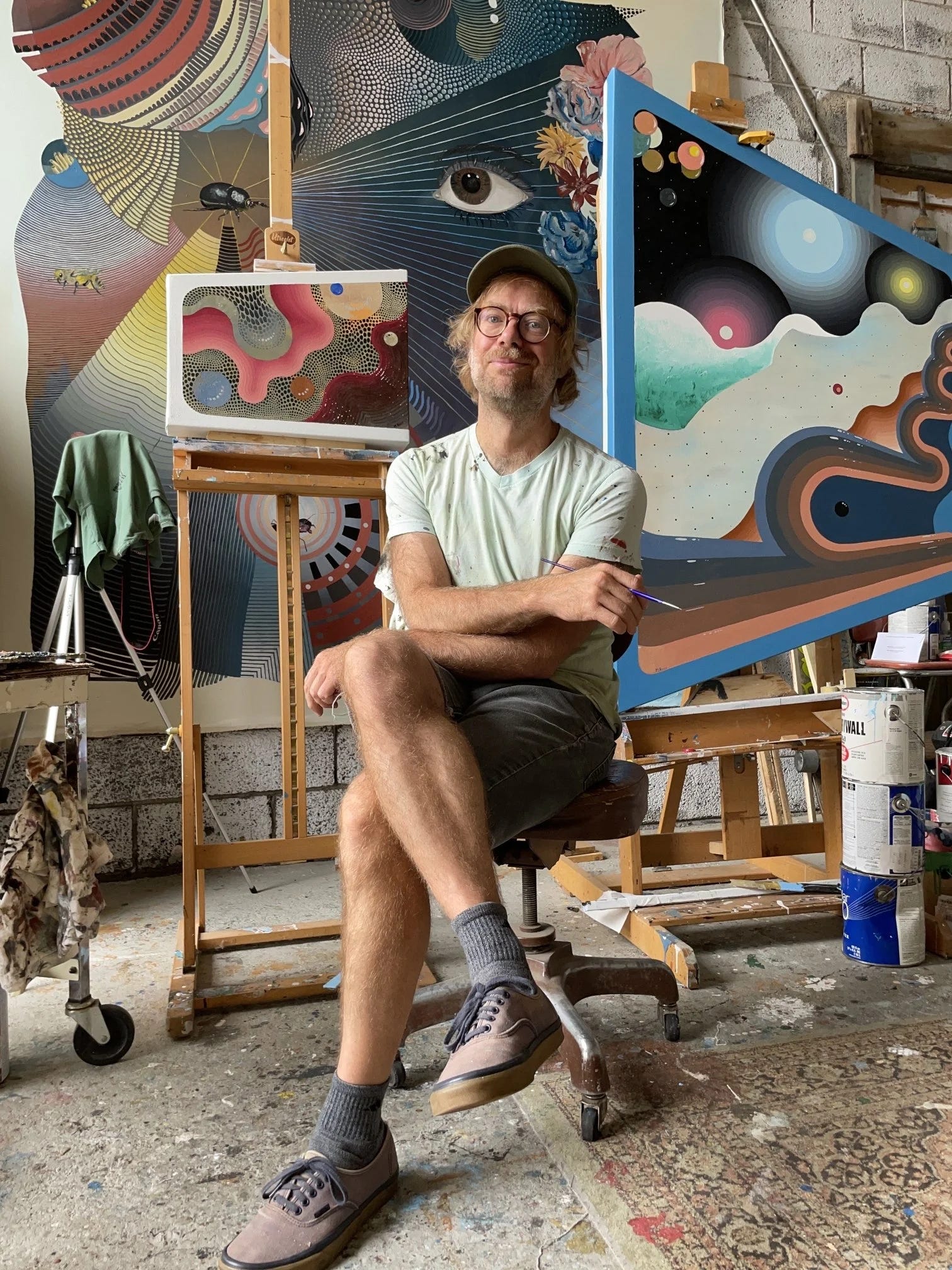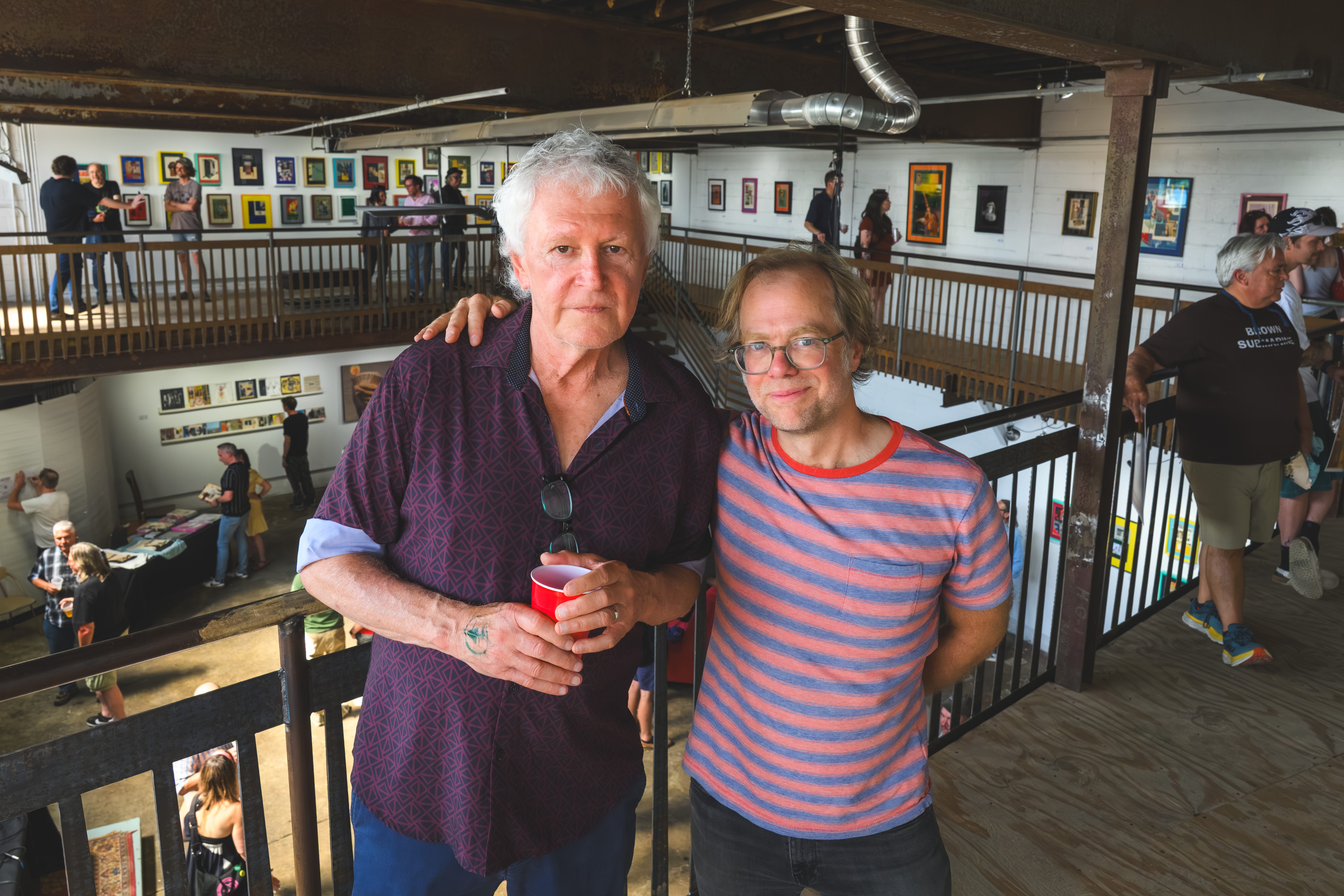
As colleague Matthew Cutter (who wrote Closer You Are: The Story of Robert Pollard and Guided by Voices) and wife Brenna Ehrlich separately reported, LOUD: The Art of Robert Pollard’s opening at Annex Gallery in Highland Park, Michigan, was an unqualified success.
A treat for Guided by Voices disciples, many of whom charted great distances, as much as an attraction for art-world movers and shakers (many of whom, I sense, come to his collages unfamiliar with his music), it was well worth the whirlwind haul.
The man himself summed it up best, speaking to Cutter: “Seeing people I haven’t seen in a while and looking at my crazy shit on the wall with them.”
I last spoke with Annex co-founder Michael Ross last Thanksgiving, as he laid the groundwork for LOUD half a year before the June 6 opening. For more on the backstory behind the exhibit, check out that interview.
At the sweltering, all-day event in a desolate industrial zone north of Detroit, it was fantastic to immerse for hours in some of the most eye-popping, eclectic, perception-warping contemporary visual art that I know.
It was also great to see, or meet in person for the first time, a number of other folks previously featured on this Substack — and to say hi to the generous, gregarious, room-filling Pollard, whom I hadn’t met in over a decade.
A few weeks later, I regrouped with Ross over Zoom to talk about how it all went down. Our follow-up conversation can be found in full below.
LOUD: The Art of Robert Pollard remains open until August 9 on Fridays, Saturdays and Sundays at Annex Gallery, 333 Midland Rd., Highland Park, Michigan.
Click here to order a copy of EAT, Pollard’s art collage magazine. For all other information on Pollard’s visual art, visit robertpollardart.com.
Congrats on a successful opening. It was packed! What’s the flow of visitors been like since?
Well, I’ve been keeping the gallery open every weekend, Friday through Sunday. There haven’t been any days where there haven’t been people coming.
A lot of times, during ordinary exhibitions, on the off days, you might get a couple stragglers here and there, or you might not get anybody. But it’s been pretty steady here, so it’s nice. A lot of people of who couldn’t come to the opening, and a good handful of people who came to the opening, but wanted to come again when there’s not crowds of people standing in front of everything.
So, it’s been pretty steady. It’s been a steady stream of the faithful.
And it wasn’t just fans; it was serious art people. What have those conversations been like?
Yeah, those are always interesting people, who don’t know anything about Bob or GBV. I’ve had nothing but positive responses from those people, who can be a little bit more critical or whatever.
I had one of our fellow resident artists here walk through — and, you know, she doesn’t know anything about them; the name Robert Pollard means nothing to her. But she walked through and took a close look, and was like, “These are exquisite. This is beautiful work.”
Which it is, you know? I mean, he’s been doing this since before he was writing songs, so he’s good at it.
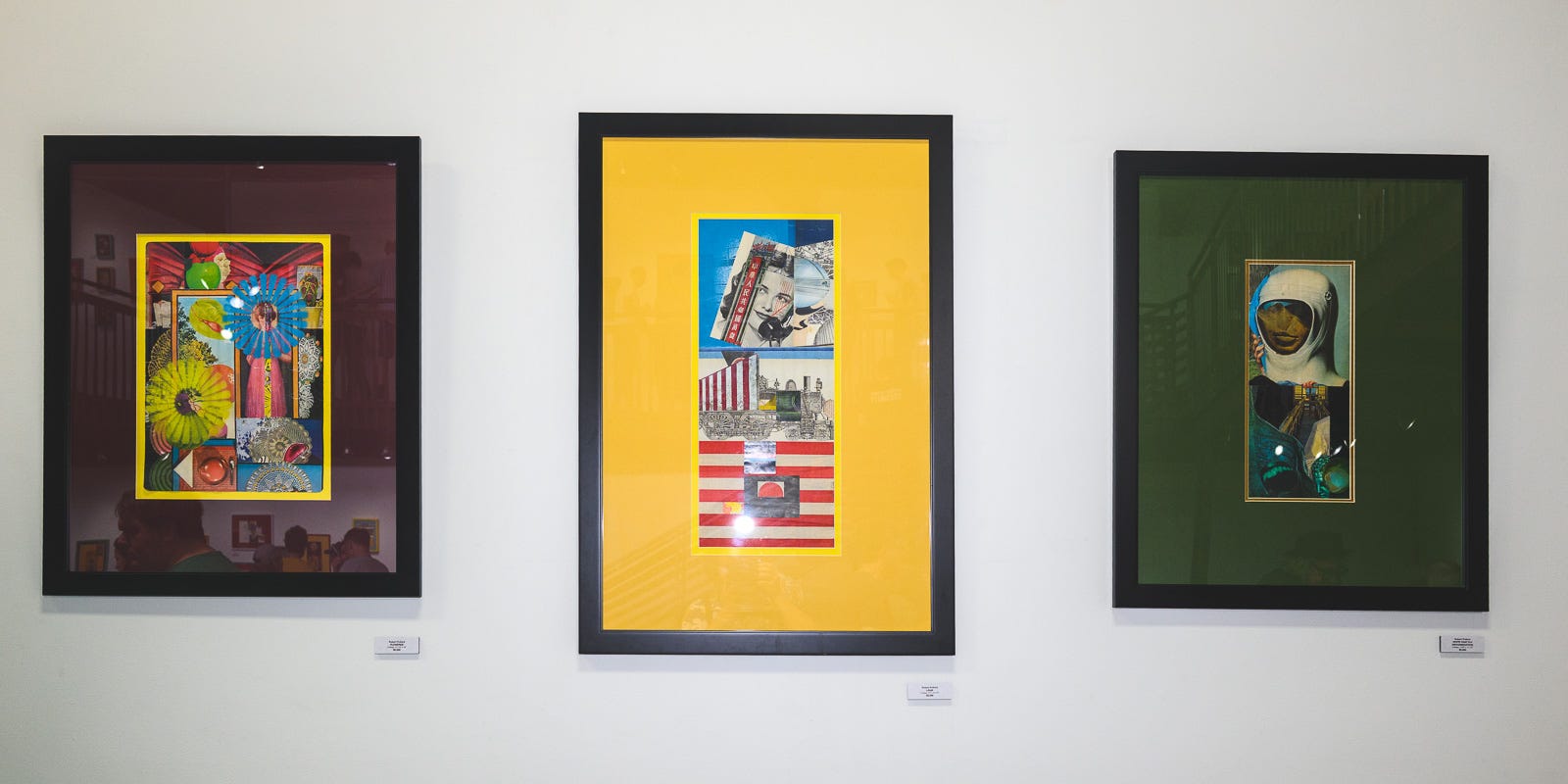
He’s got an eye for composition, and I think what makes them remarkable is they’re a lot like the way he writes songs. I know a lot has been said about this, but sometimes, there’s a wink and a nod — a sense of humor to them. Sometimes they’re strictly aesthetically beautiful. Sometimes they’re completely abstract. Sometimes they’re a direct reference to something.
He’s really got a way of putting together a picture and turning it into something where there was nothing. That’s art, right?
You guys seemed to sell a lot.
Yeah, a lot of sales, and continuing sales in the weekend since. I certainly can’t speak for him, but from everything that he was saying on the night of and everything, I think he’s stoked on it. I think he’s super excited with how it all came together, and how it’s all going.
There are nearly 200 pieces on this show, if you include the LP and 45 covers. So, while a lot has sold, there’s still plenty on the walls that are still available.
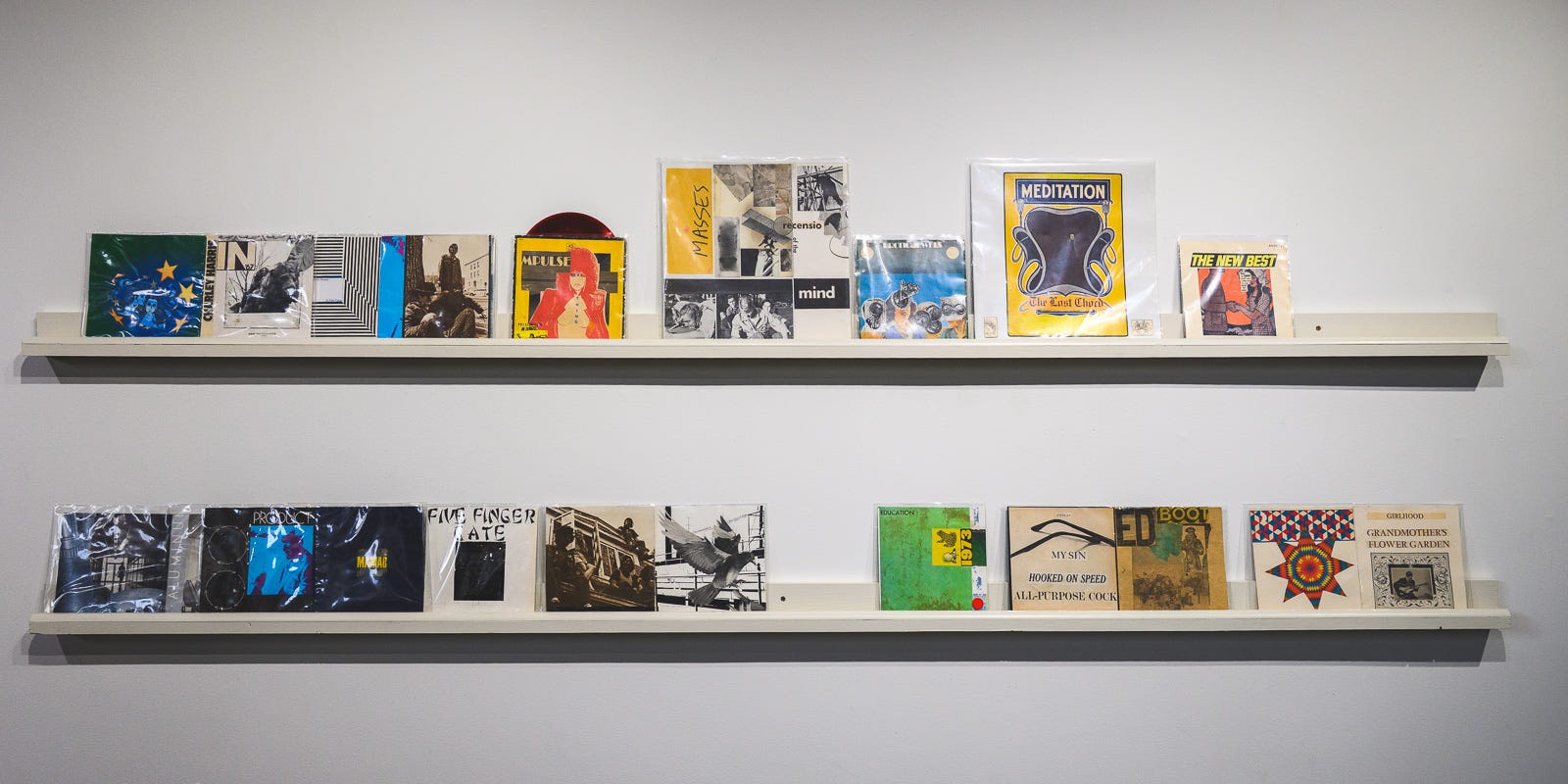
When I talked to him for a little bit, he was like, “If I want to keep it, I raise the price.”
Yeah, yeah. It was kind of fun going through, because he came in a couple nights before the opening, and we went through everything, picture to picture, and decided on prices for everything.
He just kind of did it by feel. It wasn’t by size or detail or anything like that. It’s just if he felt the piece was extra-strong and he liked it a lot, he’d price it higher. If he wanted to keep it, he’d price it even higher.
But by and large, as far as the prices themselves go, for what they are, they’re very reasonable. I mean, he went pretty modest. Most of the framed pieces are anywhere from $400 to $800, which I think is very fair. And then, some of the larger pieces and some of his favorites are a little bit higher — but for the most part, very reasonable.
And then the LP and 45 covers are between $100 and $200. At that level, it’s practically a souvenir. For someone who wants to come to the show and take home something, it’s a pretty good way to go.
I was just thinking about how cleanly all the collages were cut. No rough edges, no hanging chads.
Yeah, and if there are rough edges, they’re intentional. Sometimes he’ll just tear a piece to get that.
I read in the interview that you had done with Joe Patterson that he’s been using the same pair of scissors that he’s had since high school. It’s just some random pair of nothing scissors that you might get at the drug store or whatever. But they’re all very clean lines. Even in some of the really detailed tiny little thin pieces, he’ll get right to that edge.
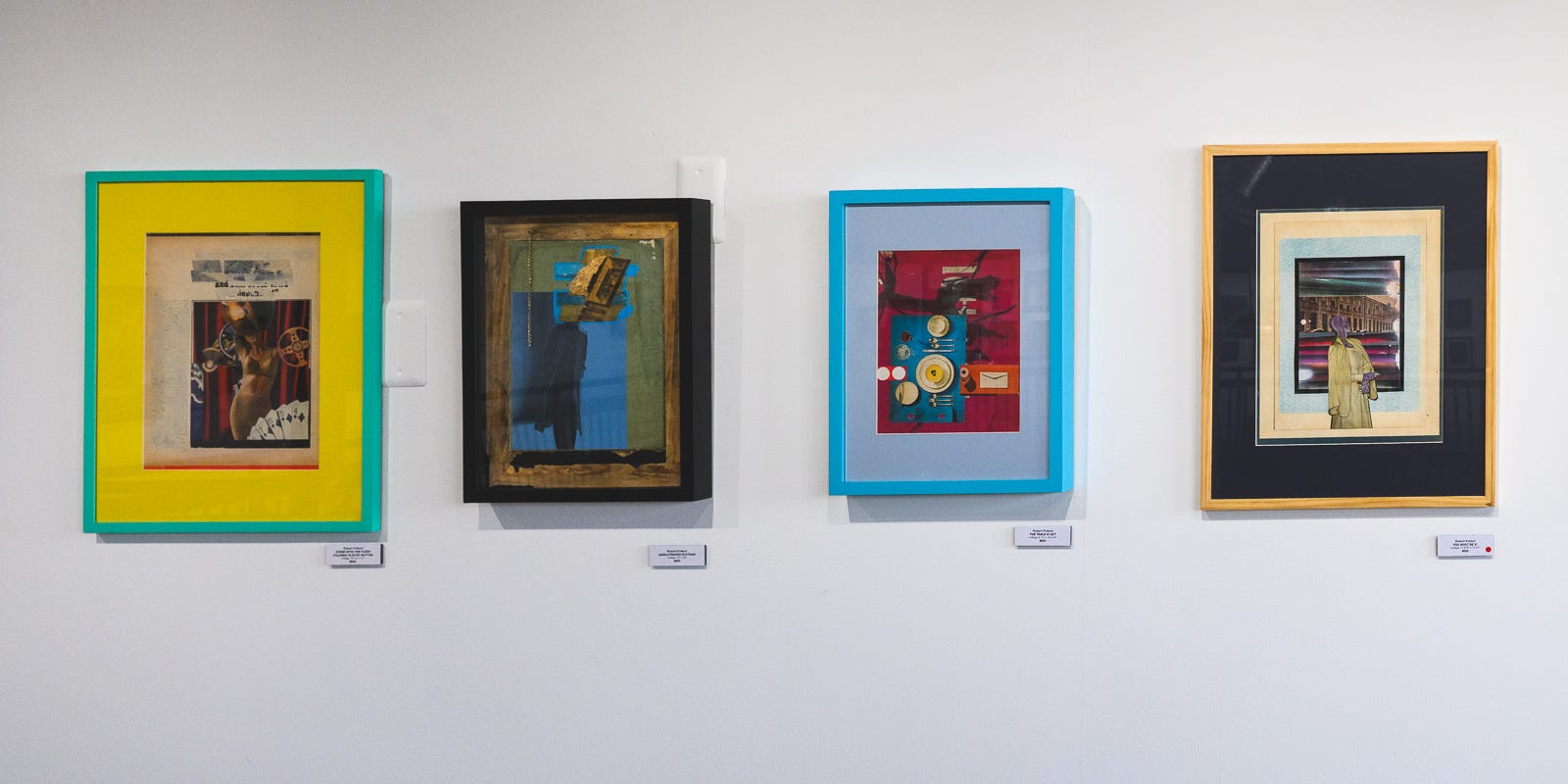
Talk about the framing process.
The framing process was intensive. His only instruction was “loud.” The name of the show is LOUD — so mats, frames, he wanted everything to be colorful.
I don’t know much about framing myself, but I’m decent with colors; I mean, I’m a painter. So I was able to assemble a crack crew of framers, who happen to be good friends of mine and know everything there is to know, practically, about framing.
I have to shout out my friend Alana [Lorin Carlson] especially. She really kind of headed up the whole framing thing, because framing 96 pieces in a limited amount of time is no small task.
So, yeah, we had a crew. I brought in Alana. Trevor [Naud] brought in this guy Chris, who worked from afar, and he made some of the larger cuts.
And Alana brought in another friend of ours, Sarah [Rayburn] — who I’ve known for years, but I didn’t know she had framing experience, and was also a huge Bob Pollard fan and owned one of his collages already — one of which ended up in the show, the Ass Fish piece you may have seen.
It’s the only older piece in the show, shown on loan. Sarah bought this from Bob back in 2014.
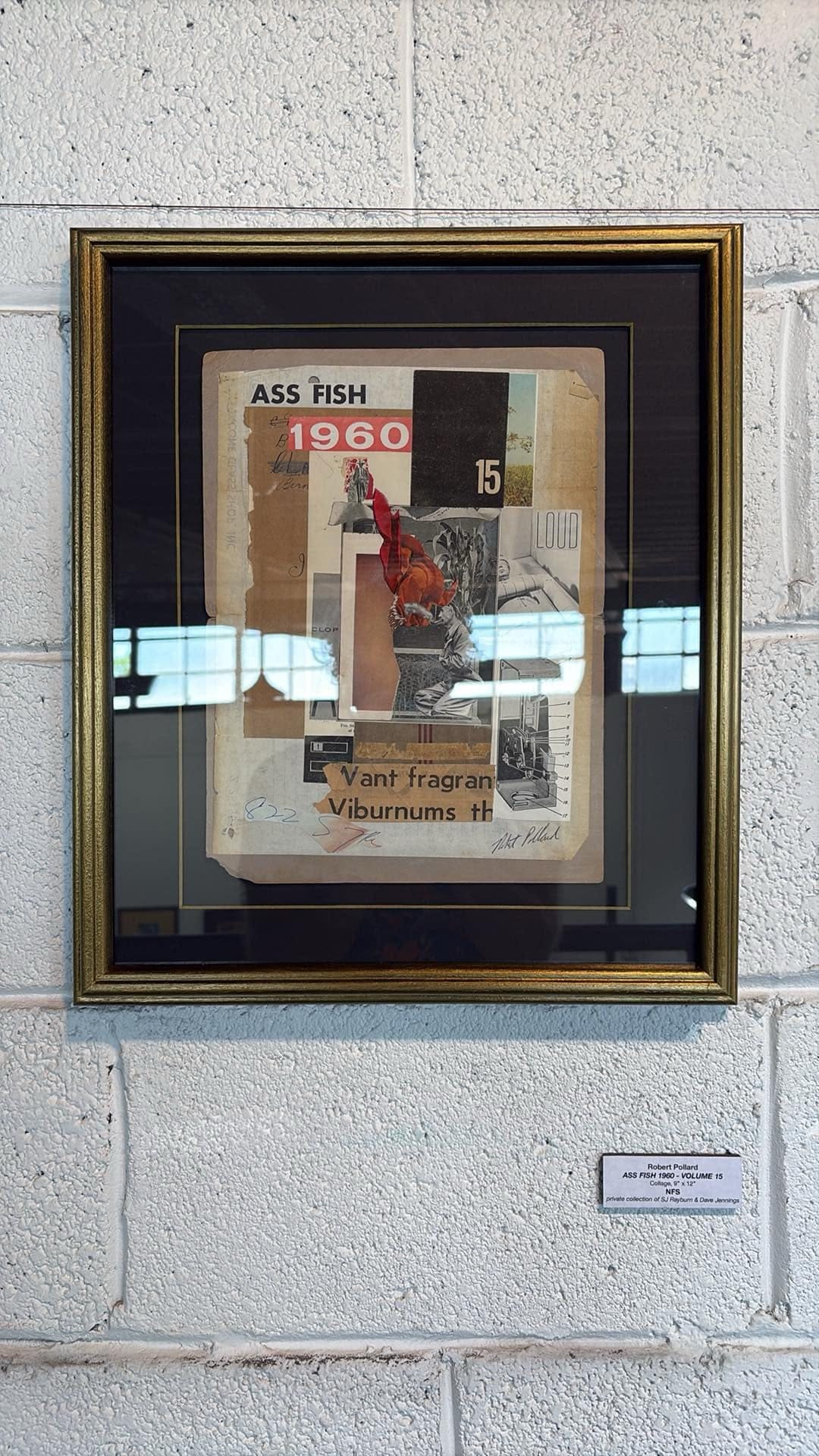
And then we brought in another friend, Alexandra [Brueggeman], who I just happened to be having a conversation with. She basically said, “I can help,” and I said, “OK, we need a hand.”
Once we really got going, we had the regular assembly line going on. We’d look at the pieces, choose the mat colors, and then from there, we’d choose the frame colors.
And, yeah, we had a nice system going. I had no idea when I asked Bob Pollard if he wanted to do an art show that I was going to end up starting a professional framing business, but that’s kind of what ended up happening.
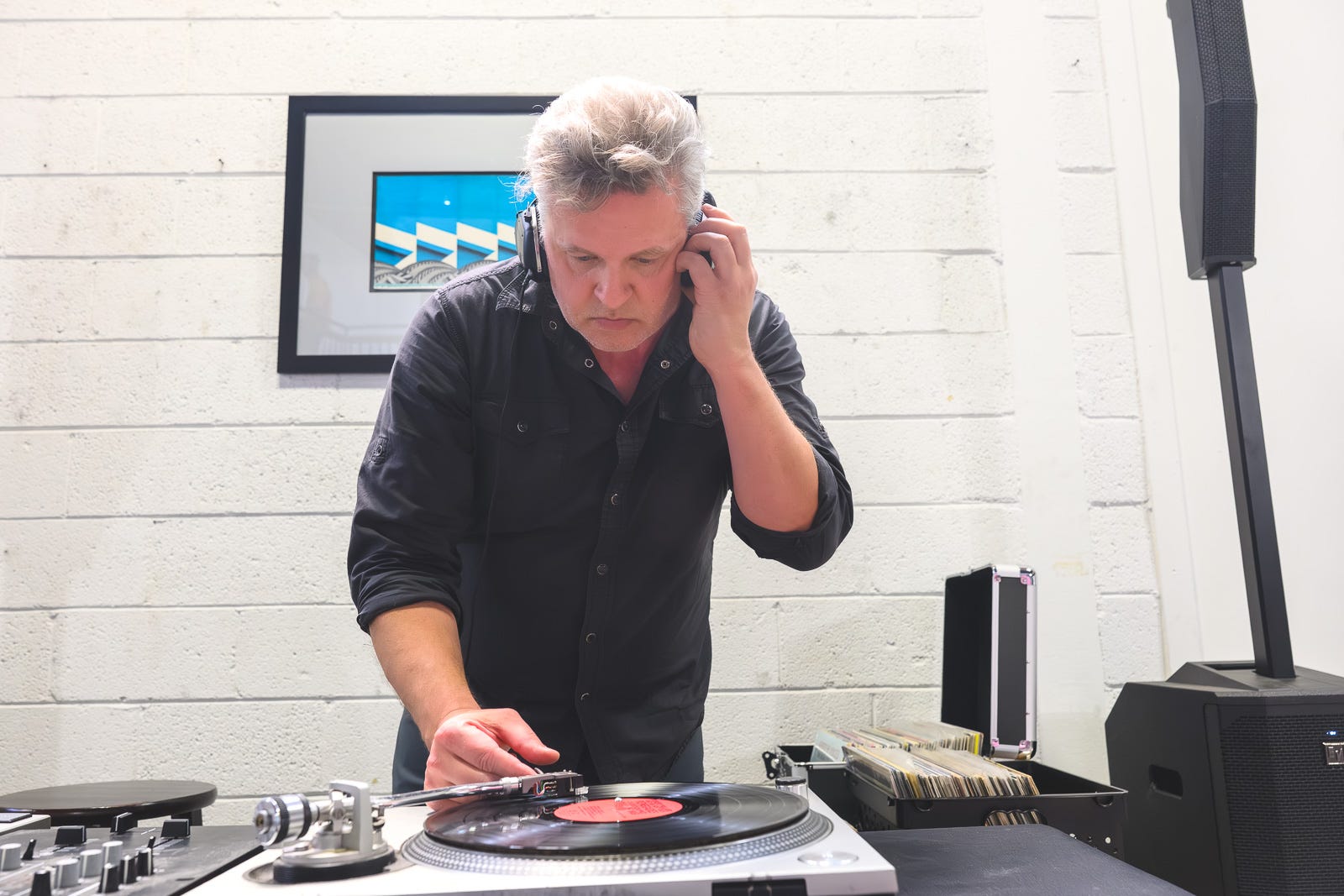
Who was the DJ? Nice work. Playing deep cuts, taking my and Brenna’s offbeat requests, hewing to the newer stuff.
That’s my friend Kirk [van Husen]. We’ve known each other for 25 years or something. We’ve played in bands together, and he has the most comprehensive collection of Robert Pollard vinyl that I’ve ever seen. I’m sure he could name maybe a handful of things that he doesn’t have, but I don’t know — maybe there’s only one or two. He’s got just about everything.
So, from the get-go, I knew I was gonna want him to be the one spinning the tunes, and he did a fantastic job. He mixed up all the various different Bob projects and GBV deep cuts and hits, and it was great — a great vibe.
What role did Trevor play?
Trevor was my right-hand man from the start. I can’t overstate how crucial he was to this show occurring!
We had only been marginally in touch in recent years, and I had the faraway dream-thought of having Bob’s work in the gallery. But it was only upon seeing Trevor’s name in some of the photo credits on the albums that the idea really hit as a thing that could even possibly happen.
I can’t stress enough how much of a role Trevor played, just in terms of having a partner in the thing. Not only with the framing and all that stuff, but just in general through the process.
This gallery is ordinarily a one-man operation. For a project like this, I knew I needed a crew, and from the start, I knew Trevor had to be on that crew.
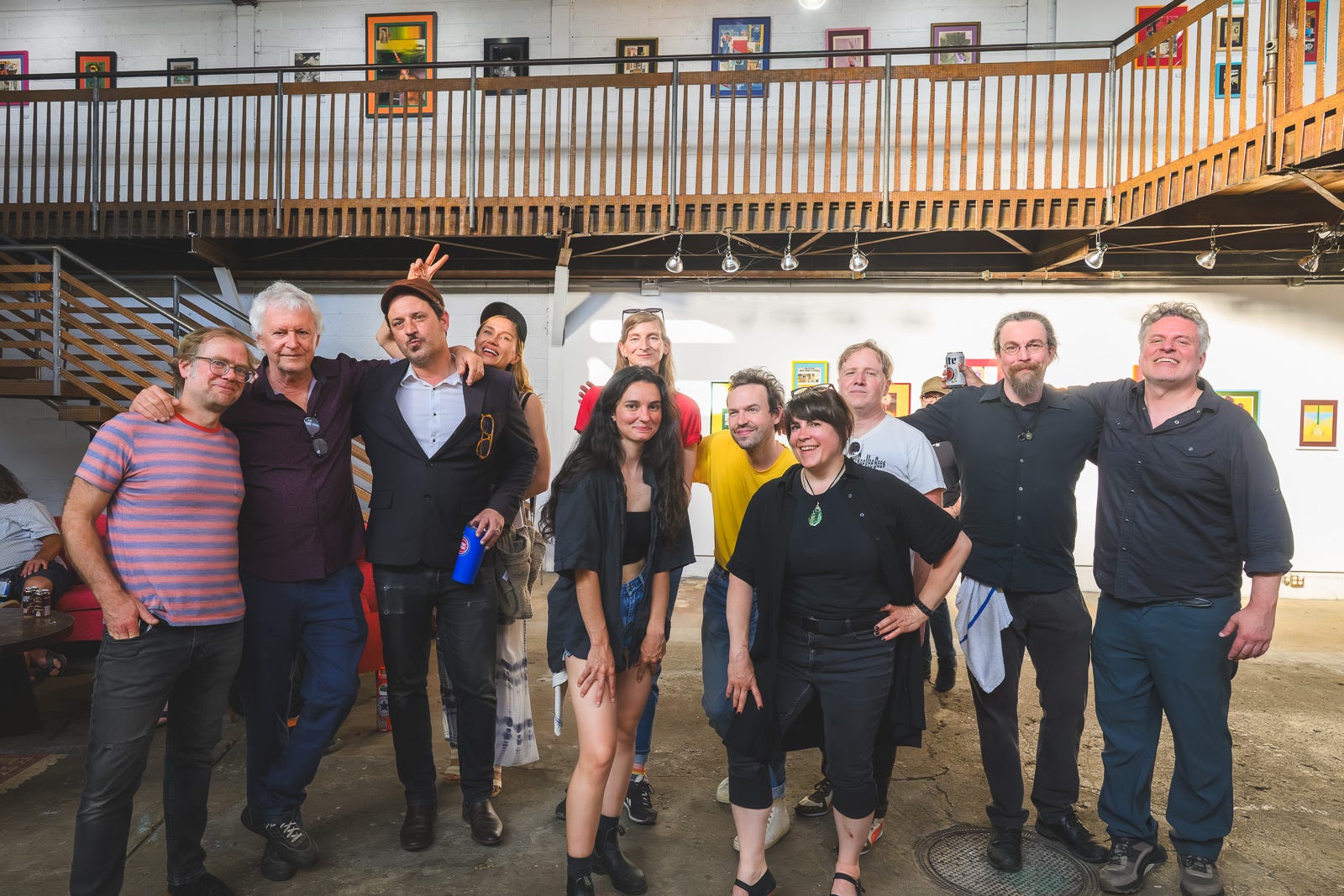
It was so much fun because it was a mix of Bob and his crew, including Mark Shue, and then just super-fans who traveled across the country. There were people who came from Oregon, North Carolina, Boston, New York, [gestures at me] New Jersey.
People came from all over the place, and it felt pretty special to be able to host this kind of event for Bob and fans, especially when there’s no touring happening. It was a place where people could kind of gather, hang out in real life, drink some Miller Lite, and sort of bask in the presence of it all.
You mentioned you’re working on a mural?
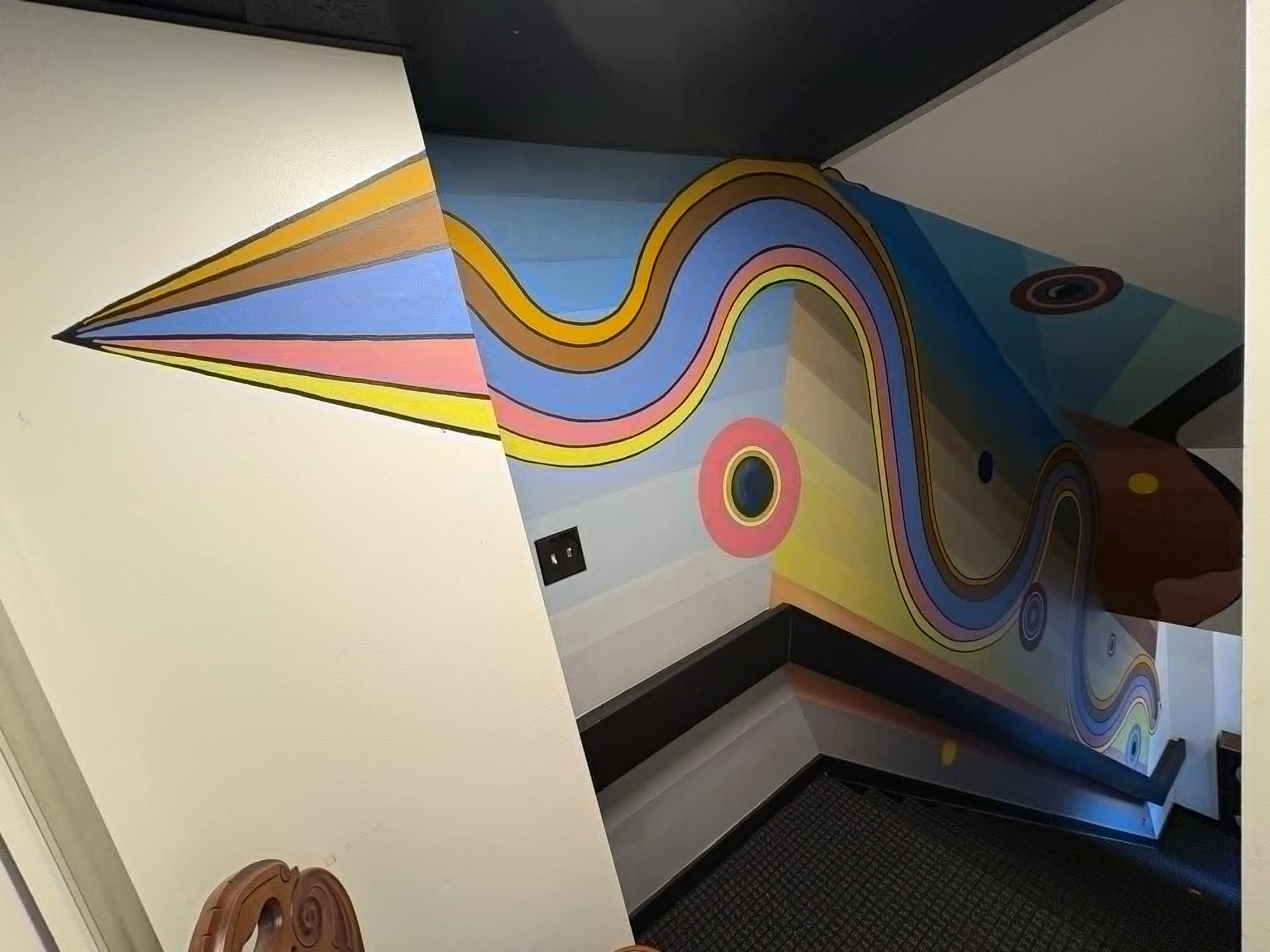
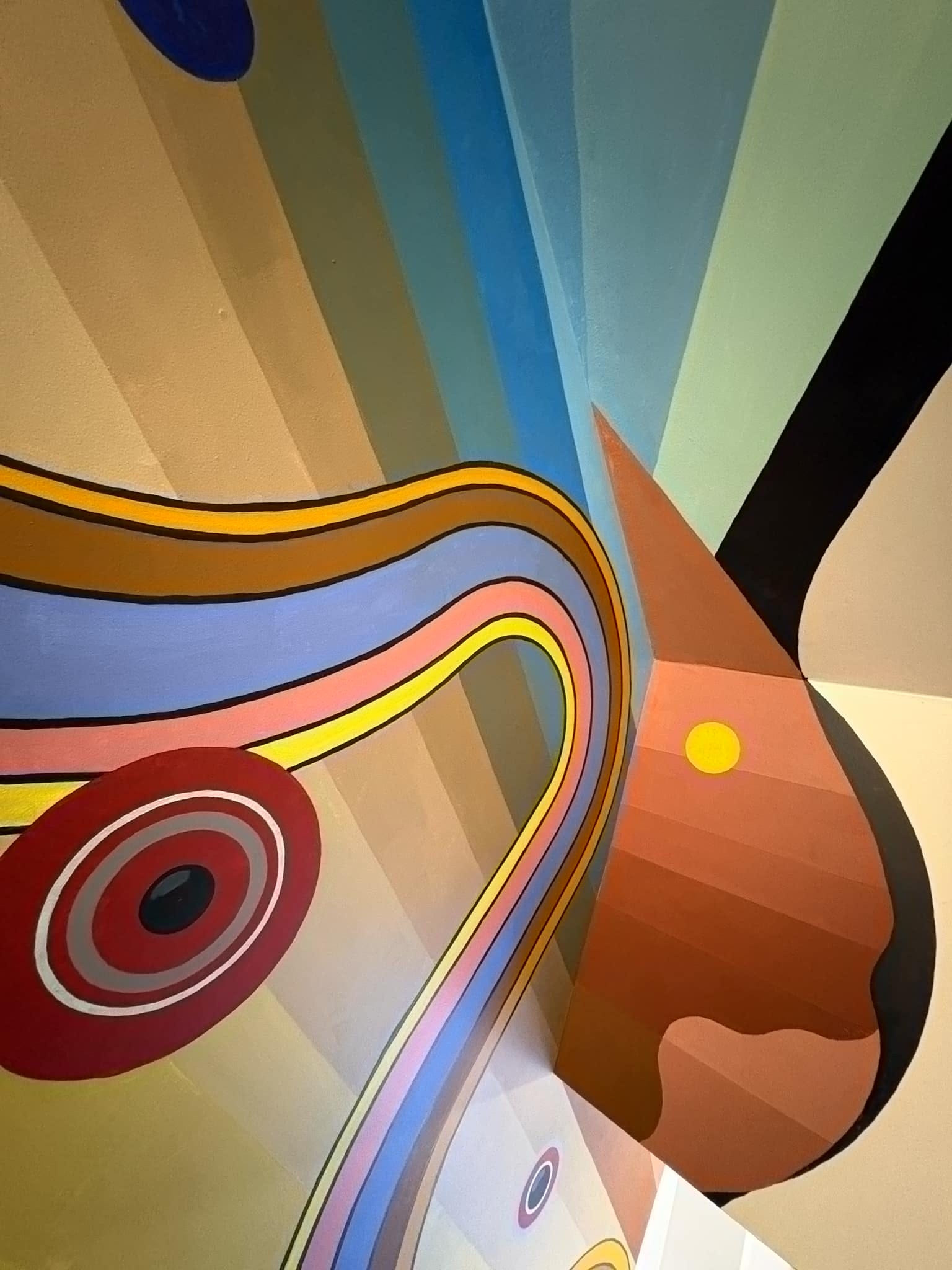
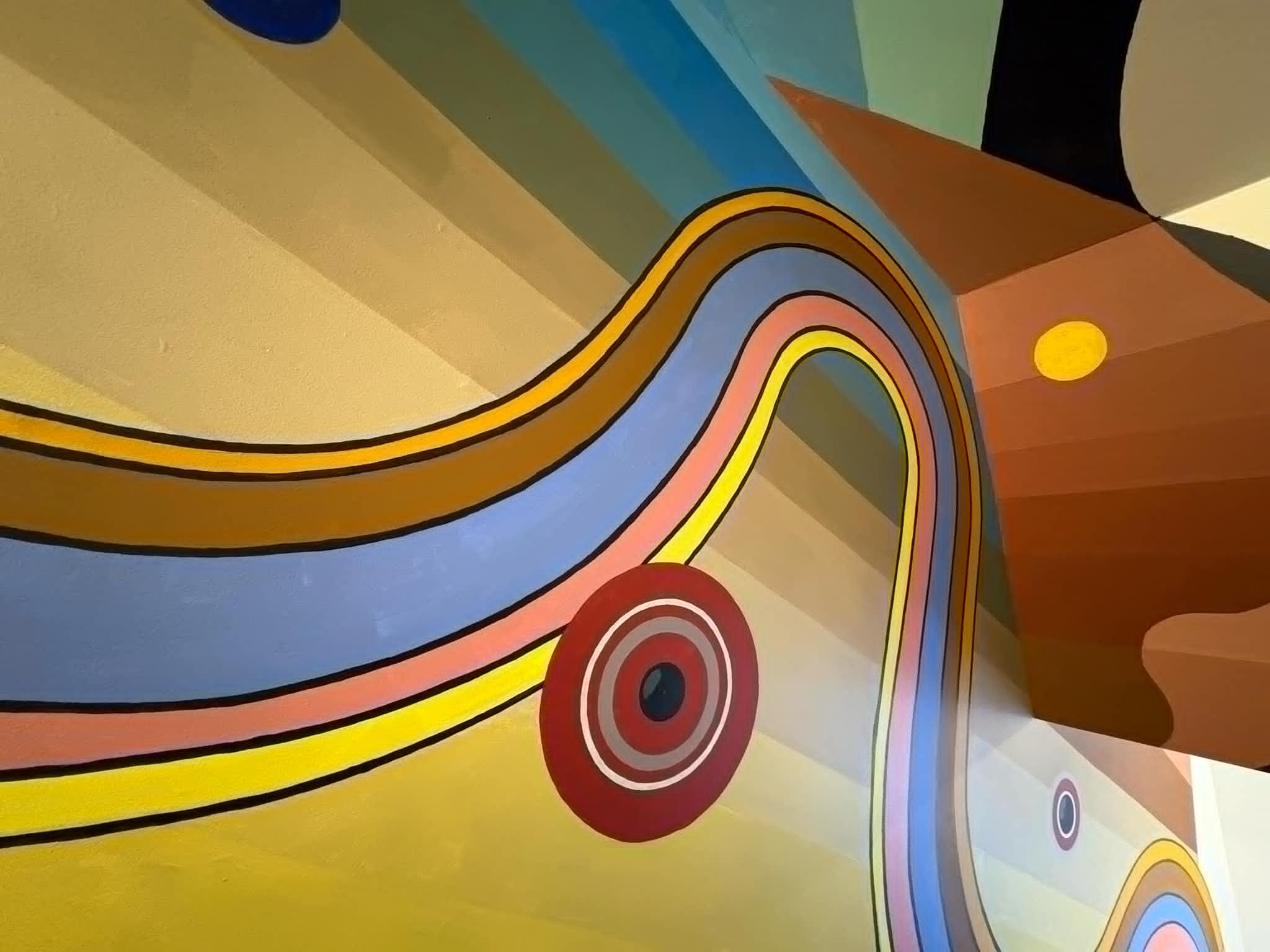
I just finished a mural yesterday, yeah — out in Ann Arbor. It’s at this place called Leon Speakers. They make high-end speakers and speaker cabinets — sound systems that I don’t know I’ll ever be able to afford, but if I can, it would be worthwhile.
They’ve got a really cool operation going on at the factory. They’ve also got a brewery, I think just because they can and because it’s fun. What I’ve been painting is basically the stairway that leads up to the showroom, so it’s jjust a big abstract mural. He said he wanted it to be musical, so I tried to make it musical.
It’s really tough to get pics in the tight staircase. Video gives a better perspective.
This project has been kind of a trip in itself. First, I had to kind of put it off for a while, because I was laser-focused on this project, but then once I got started, I threw my back out — [health] issues with my dad, various things.
It should have been a three- or four-day job, but it stretched out over, like, three weeks. But I finally finished it yesterday, so that was nice.
So if people want to visit before August 9, it’s open Friday, Saturday and Sunday?
Friday, Saturday, Sunday, 12 to 5, yep. And I will be here just about all those days. There may be some days where I find somebody else for gallery sitting, but yeah, I should pretty much be here.
What else do you have coming up in your artistic life?
Well, I’ve got a handful of murals lined up for the summer. As far as my personal artistic life, I’ve got a newish series of work that I’ve been working on that took a little bit of a back burner during this, so I’m kind of excited to get back to that.
I’ve got a show coming up in October at a place called the Jarrad Heaslip Gallery, which is a beautiful gallery here in Ferndale. Beyond that, just keeping my nose to the grindstone or whatever.
How did your perception of the man expand through this process?
I’ve always heard good things about Bob, but I don’t know that I was prepared for what a genuine, generous cat he is to hang out with. It’s been a blast getting to know him and some of his crew.
You know, I wasn’t really fully immersed in the GBV world like, obviously, so many are, so it’s been a blast getting to know some of the other fans and people who are immersed in the world. It’s such a strong, solid community. The old platitude “No assholes” really seems to hold true.
I haven’t met a single person attached to this whole project that I would have anything bad to say about. It’s been a fantastic experience, and hanging out with Bob has just been a blast in itself.
Bob is very inclusive. He includes everybody. He hung out all day, all night, talked to every single person in the room, practically. He’d have a good conversation with everyone who wanted to talk to him. He was signing things all night long for people. He’s so generous with himself and his time. I can’t say enough good things about the man, the experience, the whole thing.
I’m going to try and talk Bob into coming back up for maybe a closing thing, the weekend of August 9. So, we’ll see how that goes. He might read that here and be like, News to me — but I don’t know, we’ll see.
Thanks for being here again, Mike.
Oh, thank you, man. I appreciate it. It’s been a pleasure talking with you, getting to know you and everything. I think your Substack is a ton of fun, and it’s another great thing for fans to kind of stay in the loop on things again while there’s no touring.
I liked reading your last one that you posted with your friend [Hank Shteamer]. That was a fun one. I’ve been a pretty big music nerd my whole life, and he was talking about a bunch of bands I’d never heard of. It was fun to go through and check some of those out, because I never got into the hardcore scene much. So, it’s a fun thing for me to go back and dip into a little bit.
That band he was going on about, craw, is beyond hardcore or even math or experimental rock. It’s its own thing. They have four records, and I think it’ll blow your mind.
I’m gonna play some today while I’m here in the gallery.