

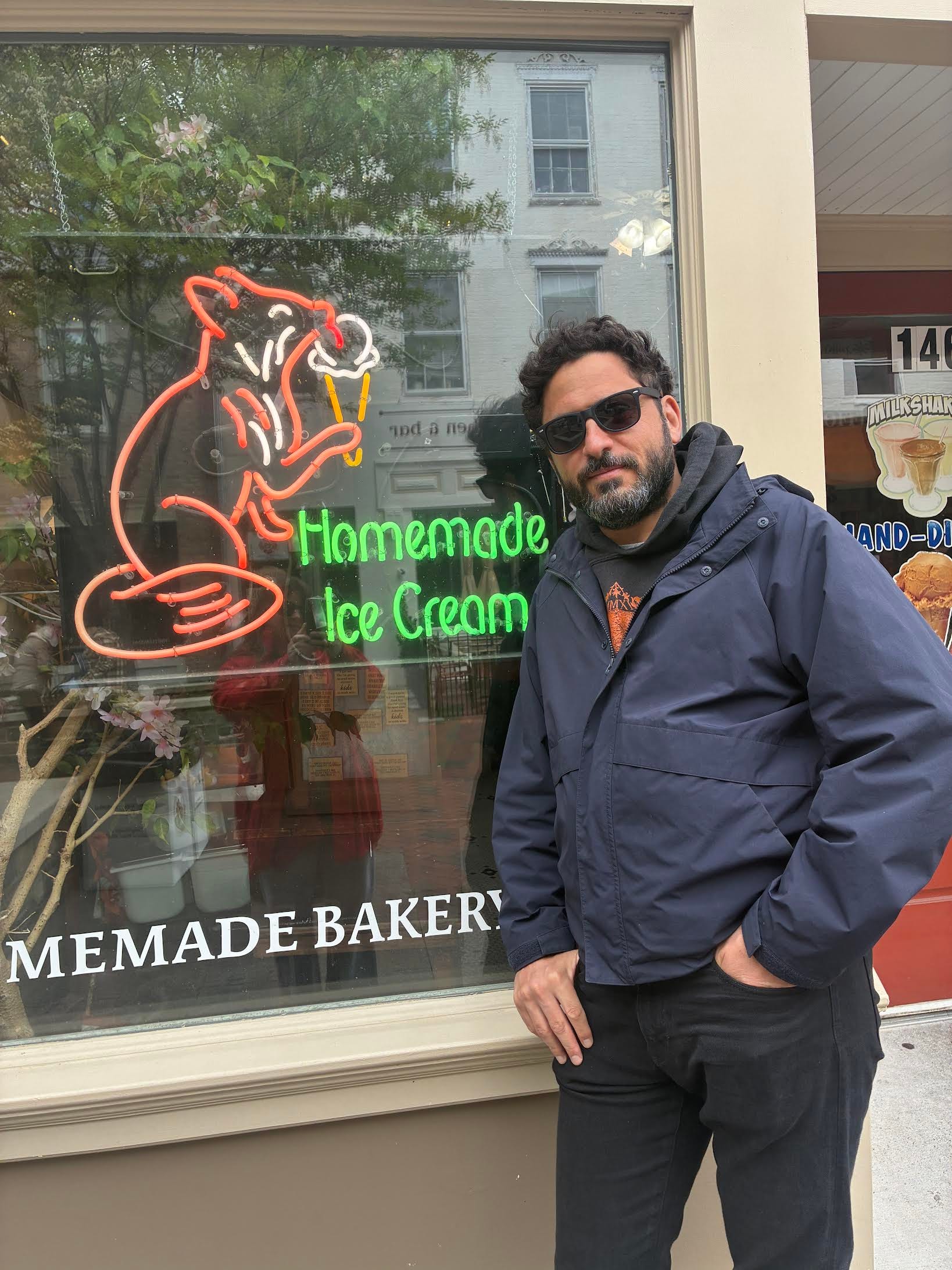
Across his decades-long career as a music journalist, editor, and podcaster, Hank Shteamer has wielded many strengths — chief among them that he a) shows up (which as they say, is 80% of success), and b) truly does his homework.
A Brooklynite via Kansas City, Shteamer attends and covers a dizzying array of gigs any given week in NYC and beyond, across rock, metal, jazz, and experimental music. Whatever the genre, context, or scene, he has a real propensity, in his words, to “put a dent” in an unfamiliar discography.
After holding a senior editorial role at Time Out New York, Shteamer was Senior Music Editor at Rolling Stone for years, with numerous bylines there as well in The New York Times, Pitchfork, Tidal Magazine, and beyond.
He later held a senior editorial position at The Messenger; upon that platform’s dissolution, he launched his must-read Substack, Dark Forces Swing Blind Punches.
Amid all this, Shteamer wrote a book about Ween’s Chocolate and Cheese for the 33 1/3 series; reissued the early catalog of his favorite band, craw; and launched an interview project called Heavy Metal Bebop devoted to the intersection of jazz and metal.
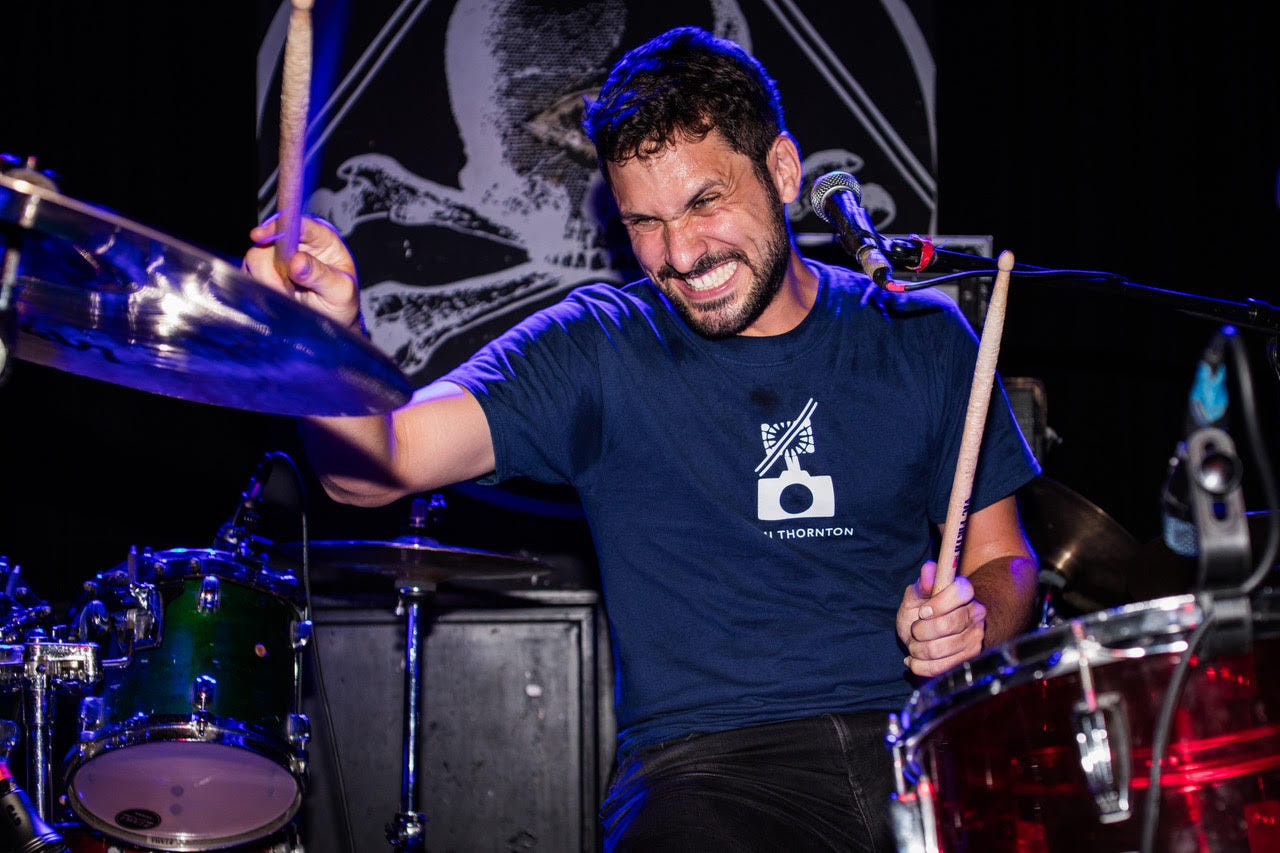
He’s also been a musician for decades, drumming in projects like STATS, Skryptor, and Aa.
Shteamer and I got into Robert Pollard and Guided by Voices in very different ways. Having 14 years on me, his introduction was Do the Collapse, back when it came out in 1999 (following a brief encounter with “Game of Pricks,” which his college indie-rock band covered).
But it wasn’t until my proselytization that he really took the dive, working backwards from the then-new Thick Rich and Delicious all the way back to their 1987 debut album, Devil Between My Toes.
(As for me, my conversion was in the early 2010s, devouring the classics and deep cuts along with the fruits of their “so-called classic lineup” reunion at the time.)
Aside from being a fantastic sounding board about music and an excellent friend, Shteamer makes for an ideal Excited Ones! interview due to his lack of calcified, received wisdom — in important ways, he’s coming at this subject cold.
Although Do the Collapse won his heart more than 25 years ago, he hadn’t spent serious time with the “big three” — Bee Thousand, Alien Lanes, or Under the Bushes Under the Stars — until 2026.
As he listened to every GBV album in reverse chronological order, Shteamer kept a ranked log, which can be found at the end of this article.
(I’ve since warned him that the solo records are next — to say nothing of Boston Spaceships, Circus Devils, and Pollard’s plethora of other projects.)
In this in-depth conversation, Shteamer talks about why Pollard and GBV won his heart, how he connects them across genres and disciplines, and much more.
Click here to visit his website.
Back in the ‘90s, did you check out Guided by Voices?
No, I was definitely not checking out GBV. This sort of classic period would have been ‘94, ‘95, ‘96, somewhere around there, that’s kind of where they’re popping? Not a word — not even a whisper of GBV.
I was a metal kid. The first music I was really into was glam metal, as it was happening when I was in fifth, sixth grade. It was Def Leppard, Guns N’ Roses, Poison, etc. Bon Jovi, whatever. And then Metallica completely changed my life. I got the Black Album and then worked backward, and that was a whole other thing.
And then, basically, from that point, it was just progressing on several tracks. One was a total obsession with metal where I kept trying to find the next, most extreme thing — finding my way to death metal by high school, being obsessed with Cannibal Corpse, Morbid Angel, and Deicide.
You’ve been showing me a lot of Ween. Had they hit you by then?
Ween did hit me. There were a couple of outlier things. It was basically like metal, and then I kind of hit the trap door into heavy indie music, and that was where that whole craw thing happened. I can detour into that or not, but after I was into the death metal stuff, when I heard craw, I was like, Oh, this is just my whole world…
Detour into it. Why did craw spiritually hit you?
Well, at the time, my friends and I were really into literature and film and art, and I was getting into Jim Jarmusch and the Coen brothers, and getting into classic weird cinema and cool fiction and Henry Miller, and surrealism and different stuff.
Like, I had metal over here, and that was like, “Satan, Satan, kill, kill, kill,” and there was no real intellectual component. There was all this stuff we were reading and watching over here, and then there was metal, and they were two different worlds.
And I found craw, and it had this sort of literary element, kind of moody — there was so much. It was like the metal bands were only coloring with three colors, and craw was coloring with, like, 100 colors.
It was just as heavy as the metal bands, and it was actually even like more of what I was looking for — music that was frightening. Morbid Angel was always my favorite of those metal bands, because when I heard it, I was scared by it. And when I heard craw, it was the same, but also they had these beautiful paintings on their covers, and it was all mysterious, and the lyrics were so offbeat.
I didn’t realize that that whole world of literature, film, symbolism, and interesting art could be mixed with heavy music, and that it could be done in a subtler way.
Basically what I later realized was that craw was just the 10-years-older version of me and my friends. They were nerdy English major kids who then got into super-heavy, fucked-up post-hardcore music. And it makes sense in retrospect that we were gravitating towards it, but that changed my life in the sense that metal is so codified. It’s narrowly defined.
And I love it for that reason. It’s not like I listen to Morbid Angel and wish they were [something else]. I’m OK with metal that’s in a box. That’s cool. I love Obituary and bands like that, where these are their rules and they never stray from them. But craw showed me that heavy music could have just a whole different dimension.
Maybe “Satan, Satan, kill, kill, kill” is like a jazz standard. Even when your version of “Lover Man” is the billionth time it’s been done, you bring something new to it.
[Laughs] Yeah, no, I think you’re right, because it’s like endless variations on these tiny little themes that people seem to just keep finding. People laugh about Deicide: how many different ways can you say “fuck Jesus”? And it’s like, “I get it, yeah. Can we move on?”
But that’s kind of the beauty of it, is: no, we’re not gonna move on, because that’s not what we do. I think, in some ways, all music and art can be broken up that way, in the sense that some art is comfortably within a genre, and the genre has rules, and it has lines you don’t color outside. And then, some art, we like it to be evolutionary and progressive and pushing, and I think both of those things are beautiful.
You know, we don’t want AC/DC to evolve. Sometimes the best thing you can do is have three colors on the palette and never experiment with anything else.
Basically, I realized that what I was looking for in music was something that a) frightened me a little bit, or a lot, and b) was so bizarre in terms of that I felt I could never truly get to the bottom of it and where it was coming from, and that it had this element of Who are these people, and what could possibly compel someone to put together sound and words this way?
Thirty years later, without hesitation, craw are my favorite band, because those qualities are still completely intact from when I first listened to them. Then, there was the added bonus of the fact they were touring the Midwest actively at that time — and they were such a cult, tiny thing that my friends and I would go see them in a room with 20 people, and then we could hang out with them and talk to them.
At least one of the guys from the band, David McClelland, became a lifelong friend. I’ve been in several bands with him, and I continue to make music with him, so it’s been this bizarre experience. And then, in 2016, I produced this reissue, and they reunited. That was a big deal, because I wanted more people to hear the music.
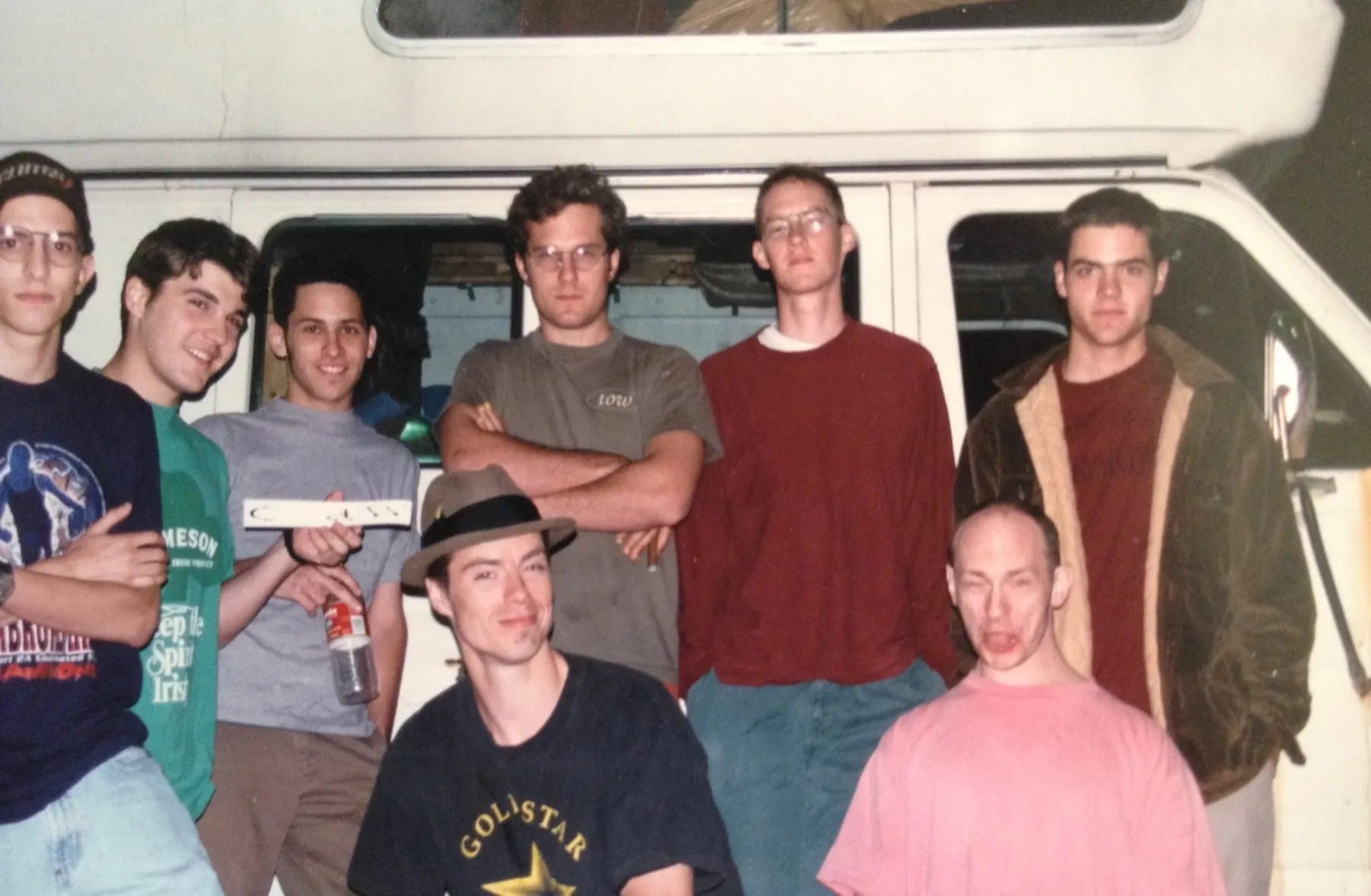
Here are my friends and I with craw after a show in Lawrence, Kansas, in 1997:
I’m always kind of evangelizing about this band. I feel like we’re living in a time of Numero Group and all that stuff, where every tiny little microscopic hardcore, post-hardcore, screamo band becomes famous after they get reissued.
That’s this whole thing of Acid Bath. Nobody knew who they were in the ‘90s, and they came back, and they’re huge. Generally, I love this kind of reissue-reunion culture, because a lot of times, I get to get into bands that I miss.
Craw will always be a cult band because the music is just too bizarre, but it’s one of those bands where the people who are into it are rabidly obsessed with it. That, in some ways, is my favorite kind of music.
But to loop back around: no, I did not even hear about Guided by Voices in high school. And if you want me to fast forward to when I first did, I’m happy to do that.
Take the scenic route if you want.
The other thing craw did was that it broke open the barrier to “indie music” in general. Because through craw, it was trying desperately to find other things that sound like them, and what I found pretty quickly was that nobody sounded like them.
But it led me to a lot of things that I loved, For example, Dazzling Killmen. Who, sadly, I never got to see live at the time, but they were contemporaries of craw, and another band doing this incredibly bizarre, complex… there’s really no name for it. Thankfully, the Killmen have re-formed and are playing shows all over the U.S. and Europe this year.
People call it math rock, post-hardcore, whatever, but all those labels fall completely flat. In Dazzling Killmen’s case, it was basically jazz students playing progressive hardcore. It was like Dillinger [Escape Plan] before Dillinger.
And then I got super into all kinds of things that were being released at that time, coming out of Chicago. Tortoise was coming out, and I got super into Will Oldham and Bonnie “Prince” Billy through Slint — because if you’re getting into weird post-hardcore, all roads lead back to Slint.
Of course, that was revelatory, like it is for everybody. And there was a cool scene in Kansas City of these kinds of post-hardcore/emo bands. There’s bands like Giants Chair and Boys Life — two of my favorites. A great band called Season to Risk in Kansas City, who played with craw a lot.
Just getting into heavy underground music — Don Caballero — and still being very into metal, and just the very beginnings of what would become the jazz obsession.
Which, I did hear a few things at that time. The thing that broke open jazz for me was hearing Ornette. I think I read some article in a magazine that said, “The most avant-garde, weird jazz you can find is Ornette’s Free Jazz.” I bought that record, and it didn’t really do much for me, but then I bought The Shape of Jazz to Come, and I completely freaked out about it.
Then I got to college and got more into jazz. I was doing college radio — I was up here in New York at Columbia — and DJing at WKCR, the venerable, legendary jazz college radio station that I fell into almost by accident. That was a huge part of my upbringing and musical development.
One of the first people I met at Columbia was a guy named Zack Waldman, who later went by Zachary Mexico as his pen name, and he was and is a great songwriter. He later had a band called the Octagon, which I absolutely love.
Zack also played in White Lighters with [future GBV producer] Travis [Harrison]. Somehow, we got connected through a mutual friend, and he wanted a drummer.
To backtrack a bit, I had also started playing drums in high school — with friends, in the basement. I was kind of self-taught, but a little bit directed by a friend. I was really into stuff like Helmet and Clutch and Quicksand, learning to play stuff like that, or trying to learn.
So Zack drafted me into this band that was eventually called Super Lucky Cat, that Joe Petrucelli — my close friend and longtime bandmate who you know through his work at the Jazz Foundation — was in, and our other friend Tom Kelly. Zack was a Guided by Voices fanatic, and that was probably the first time I heard the name. His reference points were so not what mine were.
I don’t want to speak for Zack, but I think he was much more coming out of indie rock. Pavement was a thing. I don’t think I had heard one note of Pavement in high school, or even up to that point. Zack was also a huge Ween fan who grew up in their area, and we bonded strongly over that.
All that classic indie stuff that was kind of canonical for a certain type of Gen X indie person — Dinosaur Jr., Meat Puppets, Pavement, Sebadoh — I didn’t grow up with that at all.
I later got into almost all of it — Pavement, I still haven’t quite cracked the code with, but I like Pavement. I’m not anti-Pavement. You and I have talked about this: [bands or artists that are] kind of waiting in the wings, and someday, it’ll probably hit me pretty hard. I’ve actually heard some solo Stephen Malkmus stuff that I might like even better than Pavement. But I just had no background in canonical indie rock.
So, Joe and I bonded very strongly in that band, because we both had this really strong Dischord, Fugazi thing. He had grown up very into that stuff, and we were both particularly into a band called Hoover, which was one of the most heavy, aggressive, intense, moody bands on Dischord, and just a phenomenal band.
I had become particularly obsessed with their bass player, Fred Erskine — who was also in a band called June of 44 that I fortunately got to see live back then. He’s also in a band called the Crownhate Ruin with another guy from Hoover. Incredible musician, and a huge inspiration to me. Joe and I bonded over that.
Super Lucky Cat was kind of an indie-pop band, except for the fact that their drummer had really never heard indie pop and was into death metal and prog and math rock. Not that that stuff was necessarily finding its way into the music, because they were Zack’s songs. But internally, there were all these other reference points.
Tom, our bass player, I think, had been into the Dead, for example. I should also add that I was just kind of learning how to play drums, and I wasn’t very good.
Anyway, long story short, we covered “Game of Pricks,” presumably at Zack’s urging.
Thinking back on it, I don’t even think I’d heard the original at the time. We also covered Richard Hell and the Voidoids’ “Love Comes in Spurts.” I had definitely never heard them either at the time! That was brought into the repertoire, into practice, and I learned it just like I would have learned one of Zack’s songs. He was on the GBV-oriented message board Postal Blowfish.
Through that, there was this festival in rural West Virginia featuring bands that, as I understand it, had all united because of that message board. There was another band called Anthemic Pop Wonder, and then there was this guy, Graham Smith — the incredible, prolific songwriter behind Kleenex Girl Wonder, who I’ve told you about. It was this whole community of quirky, weird indie pop dudes, and bands that were all acolytes of GBV.
The fest was called Bunkytown, and a guy named Bunk Nesbit put it on at his farm. There was a tent outside, and these GBV-influenced indie pop bands played there for two days. Super Lucky Cat played it twice, so I was amongst this GBV fan community — but, again, crazy as it sounds, I still do not think I had heard one GBV album.
That’s just not where my head was. I was getting into jazz; I was still into all the metal. I loved playing the kind of music we were playing, and I was very impressed with Zack as a songwriter and with all of these guys as musicians, but I was probably a bit out of place in terms of the style.
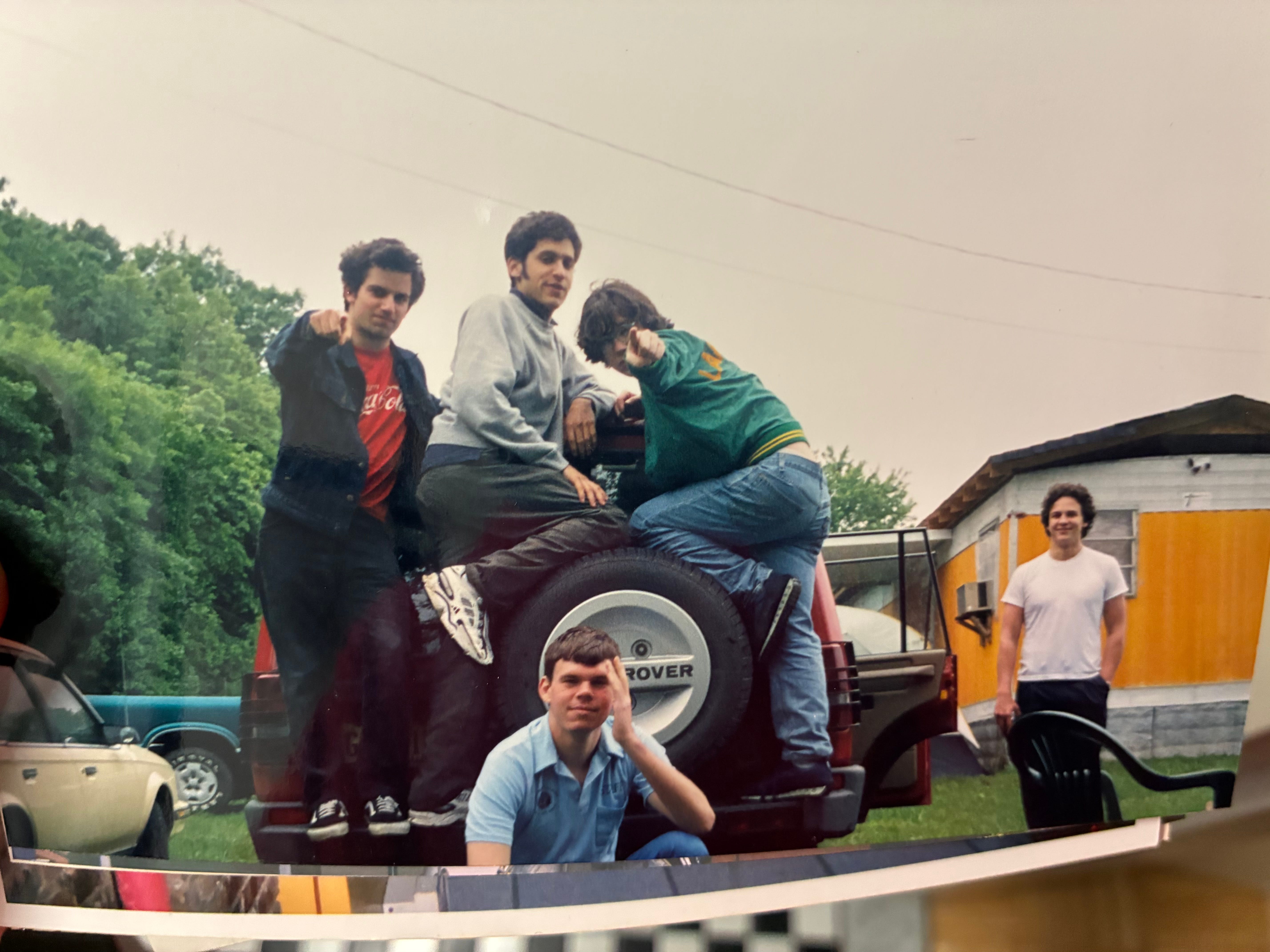
Then, from that point — if we’re following the GBV thread — I bought Do the Collapse when it came out [in 1999], because that was a pretty high-profile release. It was getting a lot of attention, and I heard it and I loved that record, but it didn’t necessarily inspire me to go back and check anything else. I just heard it, and I had it, and I liked it, and it was cool. And then I kept moving right along into whatever else I was into, and the jazz thing kept going. Writing became more of a thing.
When did you start writing with big bylines?
I was writing a bit in high school. I wrote record reviews for my middle-school paper. I reviewed a Spin Doctors album, I remember, at the time.
And there was a zine from Cleveland called CLE, where I reviewed craw’s then-new album in 1997. I got in touch with them through my craw super-fandom, and my friend Adam actually did an interview with Dave from craw. I took some of his quotes from that interview and wrote a story about them.
Then, when I got to college, I basically found my way into jazz writing because I got super into interviewing artists through the radio station. There were a couple of jazz websites. You know The New York City Jazz Record?
Sure.
OK, so back then, it was called All About Jazz, and they were very accessible. I approached them…
Any relation to the current All About Jazz?
They were all kind of part of this parent company, but All About Jazz New York was a specific thing that was run by these two guys, Laurence Donohue-Greene and Andrey Henkin, for years. Laurence still runs it, but they eventually broke off from All About Jazz and started calling it The New York City Jazz Record. But they’ve been publishing that thing since the early 2000s — maybe even before that.
I expressed interest in starting to write for them, and I got to do some really amazing pieces for them.
Some of my first — I don’t know if I’d say major, but just significant bylines: I interviewed Andrew Cyrille, the drummer; I interviewed Rashied Ali, which was mind-blowing. I also was writing for the All Music Guide. Somehow, I got in touch with the editor, and any record that didn’t have a review on AllMusic, you could pitch it and review it, and it was amazing.
Different era. Different world.
Yeah. There were tons of records, obviously, that weren’t in the database, and I could just find anything that wasn’t reviewed and review it, and they would pay me, and it was cool.
Also, there was a magazine called Signal to Noise at the time, which was sort of like an American version of The Wire — experimental music, jazz. Signal to Noise was killer. I reviewed records, wrote stories, and then I did Teach for America for two years after college, which was an ill-fated semi-disaster.
Then, I was temping for a while and eventually stumbled into an internship at Time Out New York. That was my first job in that world.
It used to be, modestly, like a more kind of middlebrow Village Voice, in the sense that the listings were kind of its heart and soul. We had very comprehensive music, film, theater, museum, and comedy listings. You could pick it up every week, and it would just tell you what was going on, and it was super cool.
And I worked with some people that I’m still good friends with: Steve Smith, who’s an amazing arts and culture, music writer, classical writer, who’s also written for the Times and a bunch of other places.
And a guy named Jay Ruttenberg, who’s amazing. He’s an indie rock guy who did some really cool stories. Sophie Harris, Colin St. John. Buddies of mine who I’m still friends with. It was a great place to work. K. Leander Williams, who did the jazz listings. I learned a lot. It was the first time I ever had a job on the music beat. I was also a copy editor there.
Eventually, I became the music editor at Time Out, and then my friend Chris Weingarten, the great writer and drummer who I knew from the NYC DIY scene, recommended me for Rolling Stone. That was 2015. I was an editor there for seven years or so, and then went freelance, and had a couple of ill-fated chapters.
I should say that Caryn Ganz was the person that hired me at Rolling Stone. Then, she left soon after, and she was my entrée into the Times. I could go in a million different directions, but that’s basically the music writing part of it.
Before our friendship and my proselytizing about GBV, how did they enter your life, or not?
So a while after that period with Super Lucky Cat and Do the Collapse, I knew that Travis was in their orbit, because Travis was a college friend, and maybe there was some slight awareness that GBV had started making records again.
But I fully credit you for refocusing me, or really focusing me for the first time on the fact that this is a rabbit hole I might want to think about going down.
I’ve been thinking about this, and I think in some ways one of the coolest things about what you’re doing with Excited Ones! is that you’re inviting people to share your enthusiasm in a very pure, straightforward kind of way.
I think as you and I got to know each other — and obviously, there was some joking around and teasing each other — but I think one of your things, as I’m sure you would admit, is there’s this almost contrarian streak about a lot of your takes.
Yes.
When you were coming out with this whole thing of — not necessarily “Forget the classics,” but “We’ve heard enough about Bee Thousand; let’s focus on what they’re doing now.” I don’t think you were quite saying they’re better than the old albums. I think it was just like, “Enough with the same three albums. Let’s talk about what’s actually happening with this band in the present tense.”
But I think there was a time when I was like, “Oh, you’re just zagging where everyone else is zigging.”
I defend new Van Morrison, so I understand why.
OK, so yeah, you make a great point there. We share the Van Morrison obsession, and I have generally kept up. Not as diligently as you have. But the newer Van Morrison albums, I like some of them. There’s some 2010s and ‘20s Van Morrison albums that I think are pretty good. But, like, nobody who is not absolutely, terminally obsessed with Van Morrison never needs to hear one of those albums. I’m sorry.
I love Van Morrison. I’ve said this before: he is my literal favorite vocalist, period, and one of my favorite songwriters, and the best Van Morrison is better than 99% of music that I’ve heard.
But I think that after a certain period — unless you’re a crazed maniac fan — you probably do not need to follow Van Morrison.
And that’s vastly different than, say, Bob Dylan. I think even a casual Bob Dylan fan should hear Rough and Rowdy Ways, for example. I think Rough and Rowdy Ways is an incredible album. He’s adding chapters to his book, whereas with Van Morrison, there’s maybe a little bit of going through the motions.
So you were kind of making this case [for Pollard and GBV’s current output], and I was kind of like, Alright, that’s just Morgan being Morgan. He’s holding this position because this isn’t the position that everyone else holds. I was taking it with a grain of salt. I was curious, but I was also skeptical of the idea that there might be hyperbole and contrarianism that was fueling your positions.
But at the same time, credit where it’s due: Your enthusiasm is contagious, and I think that’s one of your strongest suits as a journalist and writer. Your enthusiasm is irrepressible, and it’s strong, and if you’re exposed to it and you’re a curious music fan like I am, at some point, you’re going to be like, “Alright, man, well, let’s have at it.”
Because I’m always looking to learn more. I’m always looking for a listening project. I do that almost routinely — try to make a dent in music catalogs that I haven’t before. Earlier this year, for example, I did the early R.E.M. thing. I had never heard those records, and I was completely blown away by them.
I have a lot of blind spots, because I didn’t grow up with much that was canonical. I grew up on thrash metal and death metal and weird math and indie rock. I didn’t go step by step through the Beatles and Stones and Zep. I got all that stuff later — or most of it — but I did not have any kind of sequential, step-by-step, four-food-groups music listening.
It’s probably purer that way. Your mom and dad didn’t get you into it, so it’s not lodged in the nostalgia part of your brain.
To be fair, my parents did play me the Beatles in a very casual way. They are Beatles fans, but at the end of the day, they just enjoy music a lot. They’re not, like, heads.
Most people aren’t.
I guess what I’m trying to say is that I really enjoy these kinds of moments when I’m like, I’m going to tackle the Who, who I really hadn’t heard, and I got really into Quadrophenia a while ago.
I still have blind spots with the Who, but I’ve tried to topple the dominoes, as I’m able, of the stuff that everyone else seems to take for granted. I’ve just never heard a lot of this stuff.
I did make some efforts to hear those [GBV] albums that were coming out maybe five years ago. Zack might have sent me a couple of things, because he was still keeping up with it.
In the past few years, I’m pretty sure I put on Alien Lanes during a run or something like that, and maybe Bee Thousand once. But I have no strong relationship with any of that stuff. I know “Motor Away” and the few other classic songs that everyone knows.
But at this point, I can firmly state that I know Thick Rich and Delicious better than I know the big three — like, way better. I recently listened to Under the Bushes Under the Stars for the first time — I had never heard that record in full. And because of my nerd brain, I started to rank the GBV albums as I was listening.
I heard “Fictional Environment Dream” from Strut of Kings, and that sort of set something tingling in me — like, Holy shit. That song is as good as “Game of Pricks.” “Game of Pricks” is amazing, but, like, this is too.
I’m probably leaving out a little bit, because I saw Guided by Voices on the tour they did with Dinosaur Jr. in 2022. Fantastic show. And I saw them at the Bearsville Theater [in Woodstock], which had to be ‘24. I believe that show was for Strut of Kings, because I remember being super-stoked to hear “Fictional Environment Dream.”
I’d heard you say those things: “I’ve heard x canonical songs so many times, and now when I go see them, I want to hear them play the new stuff.” In that vein, I was waiting for that song, and some of the songs that got a bigger reaction from the old heads, I didn’t know them.
But the whole show was amazing — and, again, Travis is a buddy, and I was so psyched to see him doing sound.
Did you know he was behind their last 15 records or whatever?
Yes, just kind of through our friend grapevine. I remember texting him when I first heard about it — “Congrats, man, this is awesome” — because he’d been in bands, making cool records. Our band recorded with Travis several times, but he was just in a different scene. He was more into rock ‘n’ roll, indie rock, indie pop, and we were into math rock, prog. It just wasn’t the same scene.
But first and foremost, you have to understand that I know Travis as the best rock drummer on our college campus. He was a monster drummer.
I have a very strong memory of when I went into a practice room at Columbia — I must have been a junior — and he’s showing me the skip on the bass drum from “Good Times Bad Times.” They call them the Bonham triplets — the crazy, super-fast double hits on the bass drum. He was also playing “Immigrant Song.”
He had internalized this classic drum language in a way that I had not. He just had better chops. I was playing in bands, he was playing in bands, but Travis was like a professional-grade rock drummer. He was also just the nicest, coolest guy. At the time, he was, like, Springsteen guy.
“Like if ‘Thunder Road’ was a person,” as you put it.
[Laughs] Yes, I’ll stand by that. He was this Long Island dude. The great thing about Travis in college was that there was nothing “cool indie music” about Travis. He was salt of the earth, classic rock. I would hang out with him and his friends, and they were into Bruce. Travis was obviously a big Bonham guy.
It was just so interesting, because there were so many hipper-than-thou, indie-snob people at our school. To be fair, I’m pretty sure everyone was into the Strokes, who were just coming out then; Travis loved the Strokes.
But he was playing in a band at the time called Clancy that our mutual friend Eytan Oren was in, which was really good, but really hard to describe. He was kind of like a Radiohead guy, and they were this almost chamber-pop thing, but with real strong rock drums.I was also in this other cool band, Fenster Hall, that was two keyboards and drums — kind of like soundtrack music stuff.
Anyway, Super Lucky Cat, I split from at some point, and then Joe and I kind of looped back around and started this band with Tom. We were originally called Stay Fucked, and that later became STATS. From 2002 all the way up to 2017, we were playing increasingly heavy, complex, proggy math rock. Joe and I are now in a new band called Utica with Dave from craw.
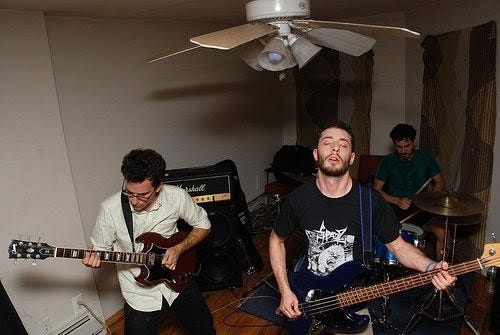
Like I said, Travis was on this other trip, and he was friends with Andy Ross, who went on to play in OK Go and was part of this whole scene of people doing almost like power pop.
Travis started Serious Business Music recording his friends’ bands playing in that style. He also had a band called the Unsacred Hearts. We didn’t stay in super close touch after college but we always remained friendly, and the various incarnations of STATS recorded with him a couple times.
Travis’s whole being is rock music, so it’s just so appropriate that he landed in this epicenter of all that is rock. To be doing the GBV thing is just so perfect for him.
Even though I hadn’t known of him as a huge GBV guy back then, it makes total sense. Though it might have this sort of indie-rock connotation, at the end of the day, it’s just a weird spin-off of these more classic rock forms. You know, the six Ps. It makes total sense that Travis would land square in the middle of that, and I’m super excited.
So, yeah — when I heard records like Strut of Kings and Thick Rich, I was like, OK, First of all, these records sound incredible, which was no surprise, because I knew that Travis knew how to do that. Also, these songs were just getting stuck in my head.
When I heard “Alex Bell” from Tremblers and Goggles by Rank, that was another one where it was like, Are you kidding me? Like, what? You can’t get any better than this. This is just so well-written, and I cannot get this song out of my head, and it’s just like an obvious masterpiece.
Through all my love of weird music and obscure underground stuff, I’m a pretty strong sucker for just a big, hooky, catchy song. Like “Teenage FBI,” or some of the more anthemic songs from Do the Collapse, let alone “Game of Pricks.” When I hear one of those big, juicy, hooky songs, I’m like, Fuck yeah.
At some point, I just decided that I wanted or needed to at least try to hear all of it: if I like these two or three records, why not try to make a dent? It’s a tough thing, and I’m sure you’ve had that thing too, where you almost assign yourself music as homework. But there was something about it; as I went back through it, I never got bored by it.
Because I had already heard those new ones, I thought I’d listen to the whole catalog in reverse chronological order and see how that played. And that’s what I’ve been doing since around last fall.
I liken this very much to reading a series of books by an author. During the pandemic, I got really into this crime writer named Ross Macdonald. His period was the ‘50s, ‘60s, and ‘70s. He was kind of in the lineage of Dashiell Hammett and Raymond Chandler. He has a bunch of books that all have the same detective, and it’s a series. I was just like, I’m just gonna read all the Ross Macdonald books, and I did, and I really enjoyed them.
But something I realized recently, because Joe was picking one of them up and asking me about it, was that I did not retain any of the plots. I enjoyed them as they were going by, but I feel like sometimes to really have read a book, you need to read it two or three times. And I feel like that’s true with albums too — that you can’t really hear an album once and get it. You can get impressions.
That’s why I had this Spotify playlist where every time a song would go by in one of the GBV albums that I absolutely loved, I would put it on the playlist so that I was keeping a record of it. But eventually, I switched to Apple Music, the playlisting thing became a nightmare, and I just didn’t have the patience to do that every time. Now, I’m listening on runs. An album equals a run; a 40-minute album is perfect for a 40-minute run.
I have this NotesApp thing where I’m ranking the albums, and every time I listen to one, I put it in the order of how I felt about it. Thick Rich has stayed very near the top.
I have Do the Collapse near the top, because it’s hard not to file it there; that’s the first one I really heard. Having gone back to it recently, I’m even more blown away by it. I know that album’s complex in the chronology and fandom — what it means to have this lo-fi band that’s got this fancy production. But for me, it was just like, These are amazing songs. Who gives a shit what the production is like?
“Much Better Mr. Buckles” — I don’t know what it is about that song. The way it starts almost in medias res. It’s kind of an atypical GBV song, but I am completely obsessed with it.
I feel like the classic Pollard trick is this thing where you feel so caught up in it, like you’d be hearing a great FM-radio song, but he manages to compress that feeling into 1/3 the time.
It has all the same effects that classic rock has, but they’re weirdly tweaked and compressed. He cuts all the fat out and finds new ways to get you to those same places without using the same structures. It’s such a peculiar wizardry.
A dimension of his genius is his scientific devotion to the weird alchemy of the hook. There was that quote that I think you shared with me: “I’m a student of hooks. That perfect combination of a lyric and a chord pattern that gives you that chill up the back of your spine.”
I don’t choose to analyze it. I fully bow down to him and that science. He has cracked some code where the rush that you feel when he hits one of those grooves is so potent. It’s like this hyper-distilled essence of stuff you might get through the canons of classic rock.
I’m also obsessed with Doug Gillard’s guitar leads that introduce the verses — just unbelievable. He plays these four-bar lead-ins to each of the verses that are so hooky and cool and gnarly and memorable.
Joe and I have a lot of aesthetic overlap in what we look for in guitar. We love these melodic hook guitar hooks. We’re both really into the Strokes’ riffs or lead guitar line — like on “Hard to Explain.”
Almost like the guitarist is a singer.
Exactly. Joe is great at that as a guitarist, and he and I have this shared obsession; we’re always sending each other songs with time codes of riffs like that. I call them leads, because it’s whatever the second guitar player is playing over the riff. But it’s a written part, not a solo.
I don’t think of it as a riff, because to me, I think of the riff as chunkier, power-chord-y aspect. Filigree is the word that comes to mind — a little splash that leads you into the verse. The way the guitar is used for that purpose in “Mr. Buckles” is godly to me.
One of my musical heroes is Stephen Egerton from the Descendents. He is an absolute god at that kind of playing — and actually, I would argue, a sort of proto-Gillard type of figure. Who knows if Gillard would even be aware of him, or if there’s any kind of overlap there.
But specifically, the band All were essentially the members of Descendents taking all these different routes, but they settled into almost a heavy power-pop kind of thing. There’s a record called Breaking Things, and there’s a song called “‘Cause.”
The lead-in before the verses, this four-bar guitar thing that Egerton plays — I’ve listened to it 1,000 times. Like you said, it’s a vocal-like, written guitar passage. Stephen is the only guitar player in that band, so he has to play both the riffing and lead role. That’s what I want to hear the guitar do in this type of music.
So anyway, yes, I have this big ranking. I’ve listened to all 40-odd Guided by Voices albums.
That’s quite an undertaking. 40-plus albums in a row…
I have taken breaks. I did a big chunk of it last fall, and then at a certain point, I think I just ran out of gas, because some of them weren’t hitting me as hard, and I’d put it aside for a week or two.
But something I keep feeling with this is: if you’re not as into the one you’re on now, the next one is always going to get you. You keep digging deeper, and you think you’ve found the bottom of it — but you haven’t found the bottom of it, because you’ll hear a record that reveals dimensions that were unprecedented in the prior records.
I also think that’s a microcosm and macrocosm thing, because this happens within a single record too.
The other day, in preparation for this, I thought, Maybe I should go back and listen to Thick Rich and Delicious to refresh. But what I actually decided to do was go back and listen to Universe Room, because it was one of the ones I had ranked the lowest. I wondered what would happen if I went back to an album I didn’t love and then saw how it struck me. Because I probably only heard that once when I filed it in my little GBV ranking log.
So, instead of Thick Rich, I listened to Universe Room. It’s funny, because hearing it again, I understand why I wasn’t as crazy about it. I think it’s a little more of a difficult, slow-burning record.
But it does this thing that you and I have texted about, where Pollard builds a 22-song record — and he might wait until, like, song 18, before he kicks into some high gear that he wasn’t kicking into on the prior tracks.
“19th Man to Fly an Airplane” is the longest song on the record. You and I have talked about this epic, “prog-Pollard” thing that he does that’s really become prominent in the last 10 records or so, where there’s these suite structures that he’s doing.
I think of them as miniature prog songs, or something, and that’s one of those songs — where you’re like, Holy shit. This guy has still got it. It’s the 12th song on a 17-song record, and the 11 songs before it… it’s a difficult record. It doesn’t have anything like “Fictional Environment Dream.”
What I realized, as is often the case with these sleeper GBV records, is that the last four songs — or the 12th, 13th, and 14th song of a 17-song album, say — are absolutely the best songs.
But what I realized listening to Universe Room a second time, after having gone through all these other ones, is that you can’t measure all GBV albums by the same yardstick. Some of them give you the classic, hard-line-drive-into-left-field thing that you want from the rockers and the anthems. But sometimes, that’s not what Bob feels like giving you.
I think the first time you listen to one of these records, sometimes you’re stuck with what you want him to be doing. You want him to serve you up the hits, and that’s not what he’s doing that time.
And then, when you listen to it a second time, you’ve managed to get past your expectations, and you’re listening to what’s there — not what you wish was there.
I did not necessarily like Universe Room more, but I did love it more, listening a second time. It was not setting off my pleasure centers the way that those real banger ones do, but I loved the fact that I could see it as part of the overall mosaic of Bob.
If I’m not that into a song: well, OK, listen to five more, and probably the sixth one, you’re going to be obsessed with. And the same thing with a record. If I’m not that into one of the records, that isn’t of any concern to me — because I’m fully on board with his genius, and I trust him.
What I happen to think of something in an isolated moment is not that important to me, because I respect the overall arc of it. And if he had to get to this one to get to the next one, then so be it. It’s not for me to say. I wouldn’t want him to edit himself so that every GBV record was just bangers, because the difficulty is part of it.
When I put on Motivational Jumpsuit — and you have to understand that this was the first time I had heard Tobin Sprout, because I didn’t know the old GBV records…
Better late than never.
But then I got to English Little League — again, very funny, song 12 of a 17-song record — “Birds” stopped me in my tracks. I was like, What in the fuck is that song? It totally fucked me up, and I’ve listened to that song dozens of times in isolation after hearing it.
That’s the Pollard thing I’m talking about. Maybe a given track is just not popping for you, for whatever reason — but buried somewhere in there, something just pops out of nowhere and grabs you.
In microcosm and macrocosm, I find that happening constantly — where I’m not into two or three albums in a row, and then the fourth album blows my mind. Or I’m not super into the first two thirds of a record, and then the last third blows my mind. He’s almost teaching you how to be a GBV fan.
It’s like you have to embrace the thing for all it is. The pace is not yours to control; it’s his to control. It’s not like, Get me to the hooks. You’re going to get the hooks, but you’re not going to know when.
I think it’s less about perversity than diversity. Every album, even if it’s not your bag, is a full meal.
And I think this is why I think this project you’re doing really has value — because you’re basically saying this whole thing that he’s doing is one art project, and there’s been a disproportionate amount of attention paid to an obviously great period of it, but to the exclusion of this enormous output.
I think you and I share this thing where we find it distasteful to just wave off decades of output because you happen to lose interest. Maybe let’s not be so arrogant that we dispense with these great artists because we happen to change our tastes. Falling out of momentary obsession with a given artist very often has more to do with you than it does with them.
I think people mistake the point at which they lose interest in an artist with the point that the artist ceases to become interesting. No, your taste just changed, and that’s fine.
And let’s be clear: sometimes artists do jump the shark. People lose the spark. The later records aren’t as good. That is a thing that happens.
Like, I referred to Morbid Angel before — one of my favorite bands of all time, and I follow them into the depths of the catalog that some people aren’t into. But there’s an infamous, notorious Morbid Angel album called Illud Divinum Insanus that’s from 2011, but it sounds almost like a bad ’90s industrial record.
The reason why it was such a letdown was because that was the album where they had reunited with David Vincent, who was the classic frontman, and everyone was like, “Hell yeah, we’re back to the classic Morbid Angel.” To be fair, there’s some good songs on that record, but it’s really a rough go.
There’s all different scenarios. Somebody can make a hard left turn. Somebody could do what Van Morrison did, where the songs just start to seem less inspired.
Then there’s another type of thing. Someone who I think is a really interesting comparison point to Pollard is Bob Mould, because Bob Mould’s standard of quality is extremely high, in my reckoning.
He was incredible in Hüsker Dü, he was incredible in Sugar, and his solo albums — especially the recent run of them from the last decade of or so — are incredible. As good as Sugar. I like the new Bob Mould albums as much as anything he’s done.
But Bob’s range and palette that he’s working with is much narrower than Pollard’s. He’s a fairly formulaic songwriter; he’s not trying to mess with the formula that much. But he’s so good at it, and his conviction and passion are so real, that I’m totally on board.
The difference with Bob Mould is that he does not necessarily surprise me and take me on these twists and turns the way that Pollard does. This is all a matter of degrees — surely something like Workbook was a very surprising turn after Hüsker! Bob Mould is a meat-and-potatoes artist compared to Pollard.
Again, it’s the thing where the road is veering off in a direction, and you’re like, I don’t know about this. Is this really a thing? And then you keep staying on the road, and sure enough, you’re 20 miles down the road, and you’re like, Whoa, how did I get here?
He takes care of you.
Yeah, I really, truly feel that. Listening to 40-plus GBV albums in reverse chronological order, I’ve never felt like my time was being wasted. I never felt like I knew what was coming around the next corner.
Universe Room is between Strut of Kings and Thick Rich and Delicious, which are pretty line-drive albums. They’re rockers, and they’re accessible. Universe, from what everyone says about it, is not a fun record in the same way. You have to slow down and get into its weird vibe.
The thing that strikes me as tragic is that somebody would be a GBV fan — into them in the classic days, for all the reasons that everyone likes those old records — and they would just have not engaged with this newer music.
In short, I agree with your thesis that fans are seriously short-changing themselves if they’re not doing that. Through your zealotry about this, and then having sort of done the homework, I think your thesis is completely sound. We don’t have to go into which is better, new GBV or old. That’s not important. But equally compelling would be my word for it.
I think, in some ways, you can’t compare new and old GBV, because there’s such a difference.
When you hear “The Official Ironmen Rally Song,” the fact of the matter is that when an artist is younger — especially a melodic singer — they have so much more range, and to hear him singing in his prime of pure vocal power and ability, that’s hard to top. He’s singing like an angel on that stuff.
Pollard does amazing things with his current range, but it’s not what he had in the ‘90s, and that’s fine. It’s different, but the songs are just as well-constructed. He’s situating his voice in them in just as much of a skillful way.
He’s more ambitious with the structures too.
100,000% agree. Like “19th Man to Fly an Airplane” or other examples of those sort of GBV prog songs. And when I say “prog songs,” I mean that there’s multiple discrete sections that, if it was the ‘70s, it would have been a 20-minute song, but he does it in four.
Your thesis is that this is an extremely vital ongoing art project, and that’s your pitch, as it were, with this Substack. I’m saying that I have signed up for the mail-order Morgan Enos GBV course, and I’ve received the study materials, and I’ve reviewed them, and I buy your thesis.
If you follow the Morgan Enos program, you’ll probably be delighted by what you discover in the music. That, to me, is sort of the highest service as a music journalist.
Culture journalism is collapsing, and everything’s kind of moving to Substack. And I think it’s an interesting thing that you’re doing this with approval of the band. It’s not traditional journalism in that sense, because you’re doing this as a sanctioned project — like an authorized biography.
I think that is so perfect, because your project is essentially one of advocacy and fandom. Even if you had free rein, it’s not like you have critical takes of Guided by Voices or negative takes that you’d want to publish anyway. So, who cares that it’s all sanctioned, because anything you’re going to say is all in service of the enthusiasm.
You came into this business, and obviously, you had an amazing run at Grammy.com and all that stuff. But you came into this at a time where you’re kind of sifting through the rubble of this industry, and you’re making your own way, as we all are.
But you found this thing where you don’t have to worry about the part of it that’s, like, traditional journalism. In some ways, this is more like the best parts of a zine combined with that specific thesis and perspective that you have. I just enjoy that it’s this hyper-focused thing, all in the name of fan service.
I think it’s cool to see the project flourish, because I think that it is such a rich world. You kind of could talk about this band forever and never run out of things to talk about.
Guided by Voices, Best to Worst*
by Hank Shteamer
Bee Thousand
Do the Collapse
Welshpool Frillies
Thick Rich and Delicious
Alien Lanes
Tonics and Twisted Chasers
Please Be Honest
August by Cake
Space Gun
Mirrored Aztec
Crystal Nuns Cathedral
Tremblers and Goggles by Rank
Strut of Kings
Vampire on Titus
Self-Inflicted Aerial Nostalgia
English Little League
Same Place the Fly Got Smashed
Crawlspace of the Pantheon
Under the Bushes, Under the Stars
Mag Earwhig!
Earthquake Glue
Devil Between My Toes
Class Clown Spots a UFO
The Bears for Lunch
Sandbox
Propeller
How Do You Spell Heaven
Motivational Jumpsuit
Isolation Drills
Zeppelin Over China
Sweating the Plague
Half Smiles of the Decomposed
Let’s Go Eat the Factory
Surrender Your Poppy Field
It’s Not Them. It Couldn’t Be Them. It Is Them!
Universal Truths and Cycles
Warp and Woof
Nowhere to Go but Up
Styles We Paid For
La La Land
Cool Planet
Universe Room
Earth Man Blues
* Subject to change at any moment.
Great read. So interesting to see Hank’s list, to see how all of the albums hit one set of ears when consumed in one chunk instead of being parceled out over decades.
Whew! What a read! Hank knows his stuff! Great fun to read about his music journey to GBV, with a bit of GBV NYC fanboy nostalgia thrown in with Super Lucky Cat, Zack, Octagon and more. And the 2000 Bunkytown music fest! THAT was a hella fun weekend! Happy I was there, too!